
BENCHMARKS (2026)
This project begins with an apparently simple object: the bench. Dozens of wooden benches, originating from the former courthouse of Hasselt (BE) , carry a past that cannot be erased. For decades, they formed the silent backdrop of justice — places where people waited, listened, hoped, and feared. Here, lives were turned around, truths were weighed, and judgments were pronounced.
Each bench carries memory. Not only in visible traces, but in charged moments: the sticking of chewing gum beneath the seats, the held breath, the tension between guilt and innocence. Thousands of bodies have sat here — vulnerable, tense, sometimes resigned. The benches absorbed this human intensity and still preserve it, as silent witnesses to justice and injustice, punishment and forgiveness.
The title “Benchmarks” deliberately refers to a double meaning. On the one hand, it literally means benches — the objects themselves, tangible and laden with history. On the other hand, it refers to the concept of a benchmark: a point of reference, a standard of measure. Within the context of justice, things are constantly measured, weighed, and judged. What is truth? What is justice? Where does the boundary lie between guilt and innocence?
These benches are therefore not merely physical objects, but also symbolic points of measurement. They confront us with fundamental questions about judgment and morality. Who determines the norm? And how does that relate to our own inner sense of justice?
By removing these benches from their original context and placing them in a new space, a shift occurs. What was once functional now becomes reflective. What was once part of a system now becomes an invitation to silence and awareness.
“Benchmarks” invites the visitor to take a seat — both literally and figuratively. To reflect on the traces left by others, and on one’s own position within a world in which we are all, at different moments, both judge and accused.
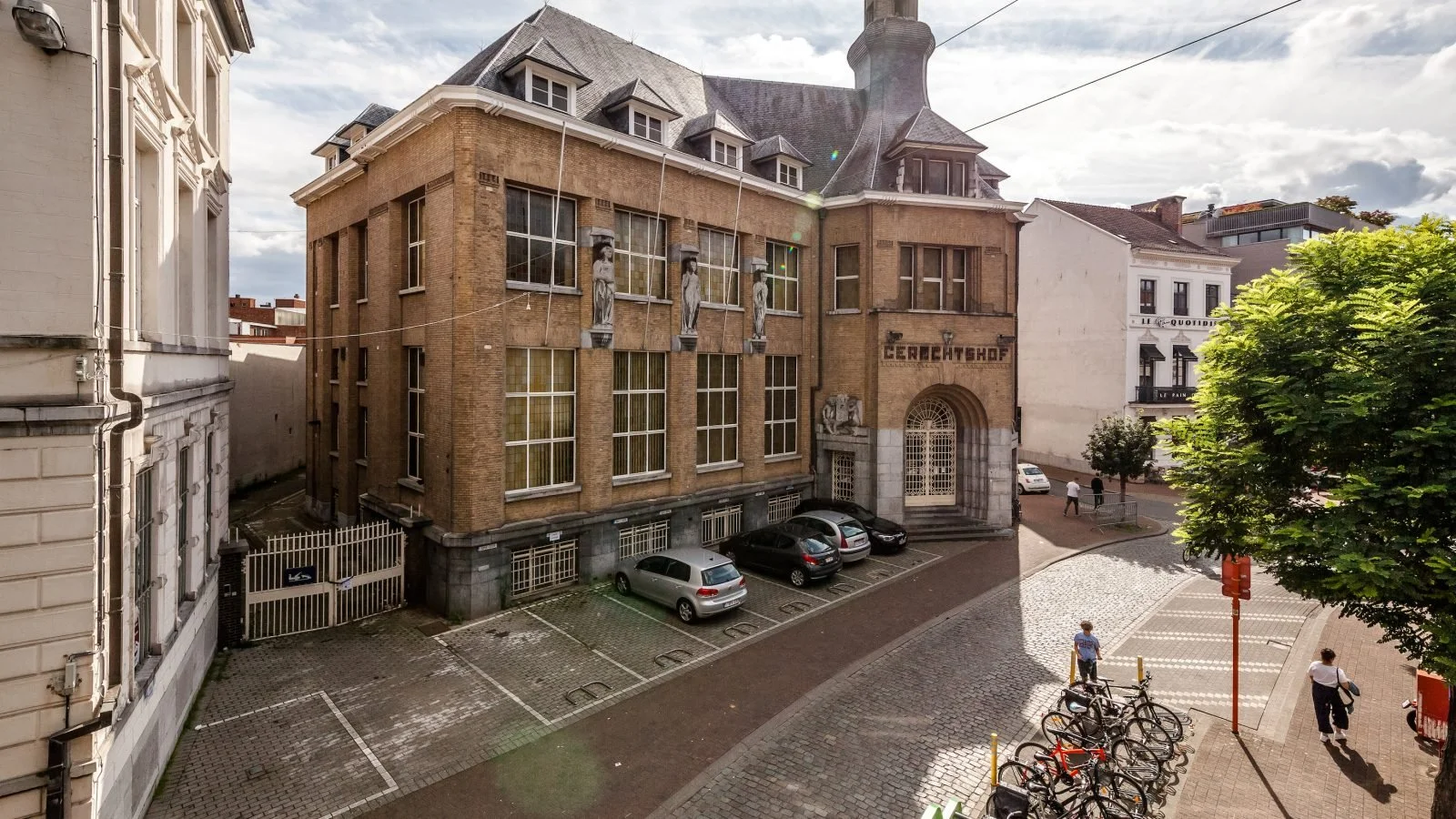
Old court of justice
2026
Hasselt (BE)
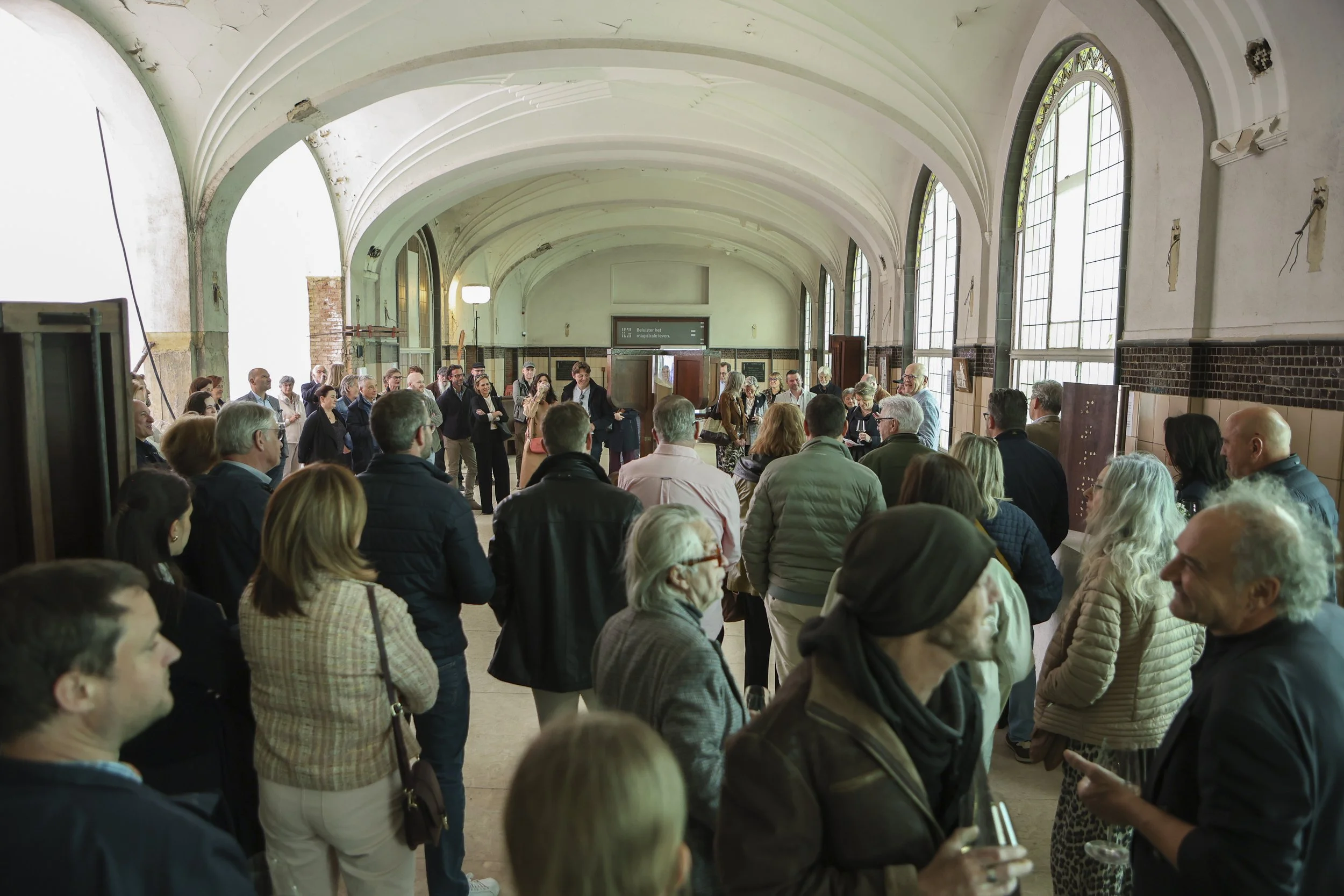
Benchmarks Vernissage
2026
Hasselt (BE)
SELECTED WORKS:
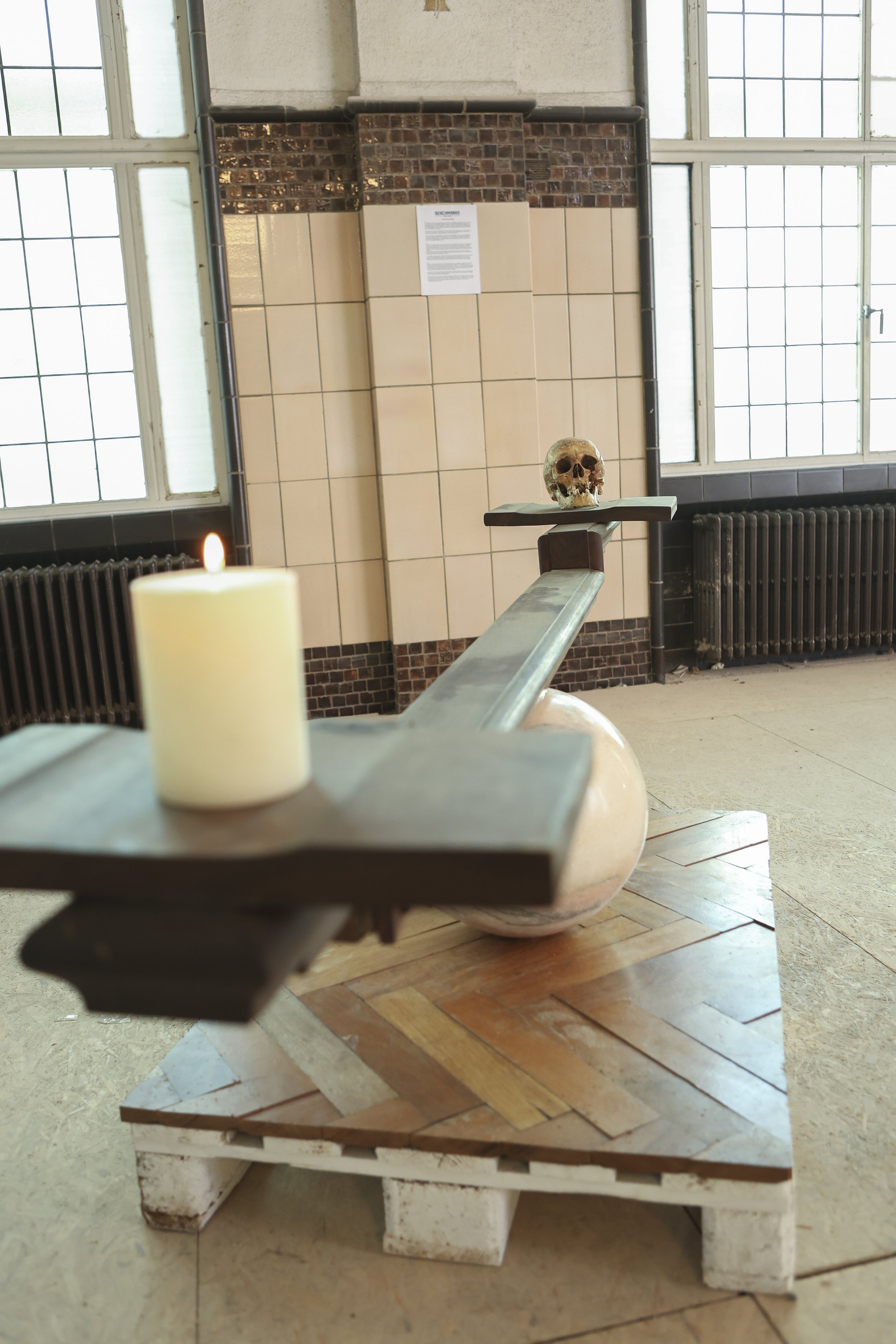
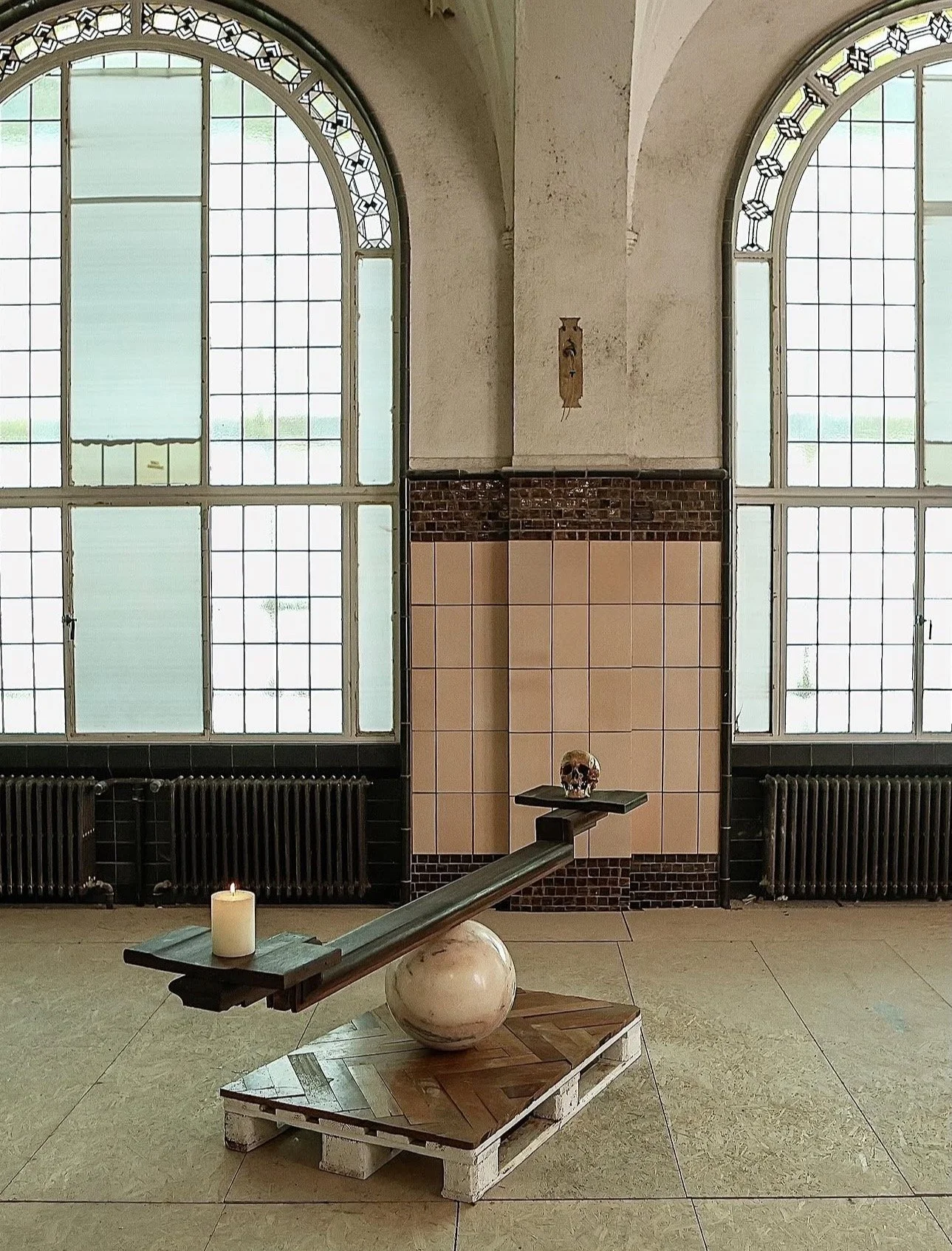
In “OP DE WIP (IN LIMBO)”, a fragile marble sphere occupies the center of the installation, presented on a white pallet that refers to the ongoing works and transformation of the space. Resting on the pallet is a layer of authentic parquet flooring originating from the former courthouse. The marble evokes vulnerability and refinement, while simultaneously recalling the image of a globe: a symbol of a universal and global legal system. Hope, transience, power, and loss are emotions present all over the world, regardless of where justice is spoken or enforced.
Above it stands a construction that simultaneously recalls the scales of Lady Justice and a playground seesaw. The ends, made from parts of a courtroom bench, function as seating surfaces on which weight and counterweight continuously influence one another.
On one side lies a human skull, symbolizing transience, decay, and the inevitability of time. On the other side burns a candle, representing hope, guidance, and humanity. As with a seesaw, movement only occurs through the presence of another weight. The installation illustrates how people within social and legal structures are constantly balancing between hope and death, power and vulnerability, rising and falling.
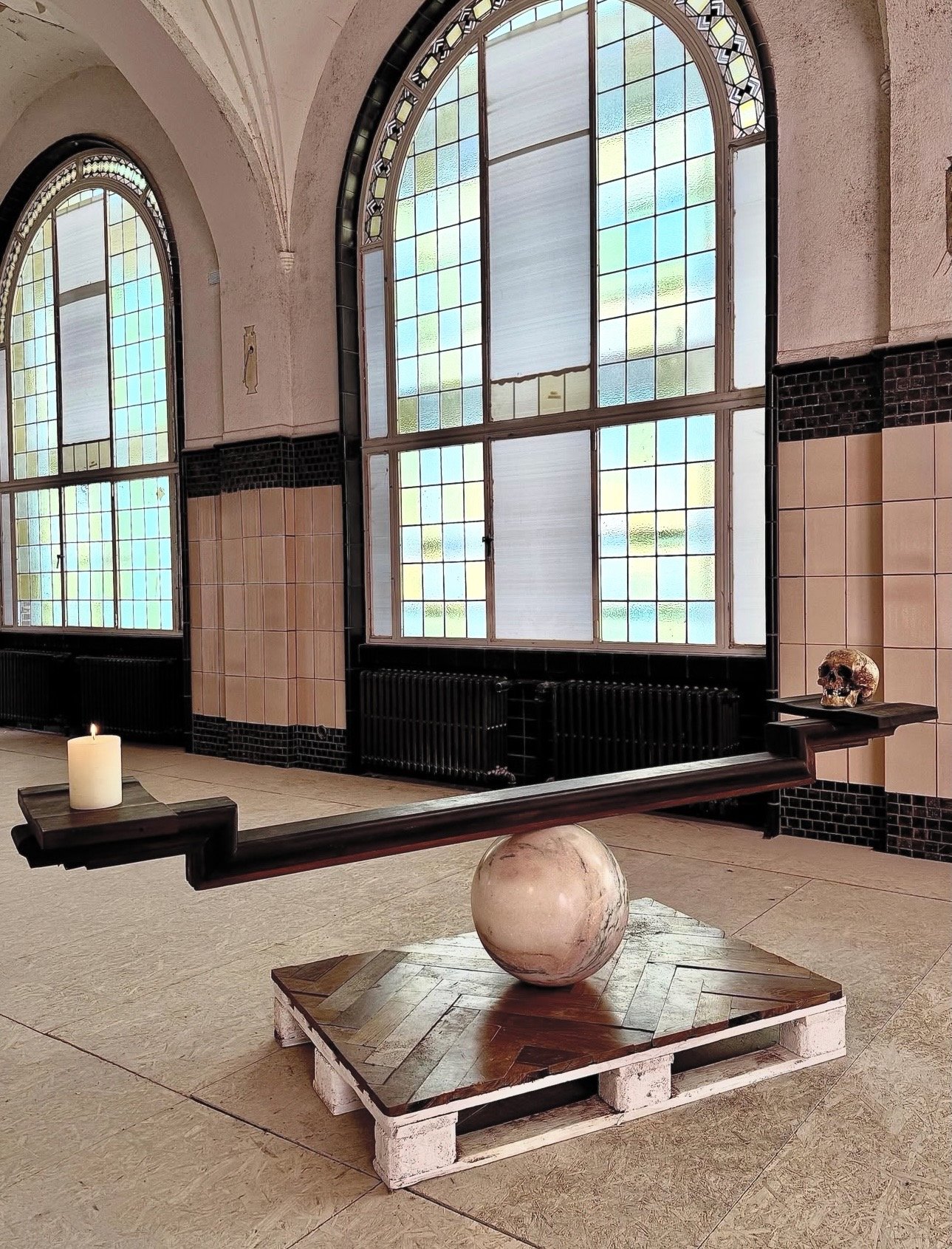
OP DE WIP (IN LIMBO)
2026
238 x 44 x 75 cm
Wooden pallet, Authentic courthouse parquet flooring, Authentic human skull, Pink marble sphere Ø 50 cm, Authentic fragment of a courthouse bench, White candle
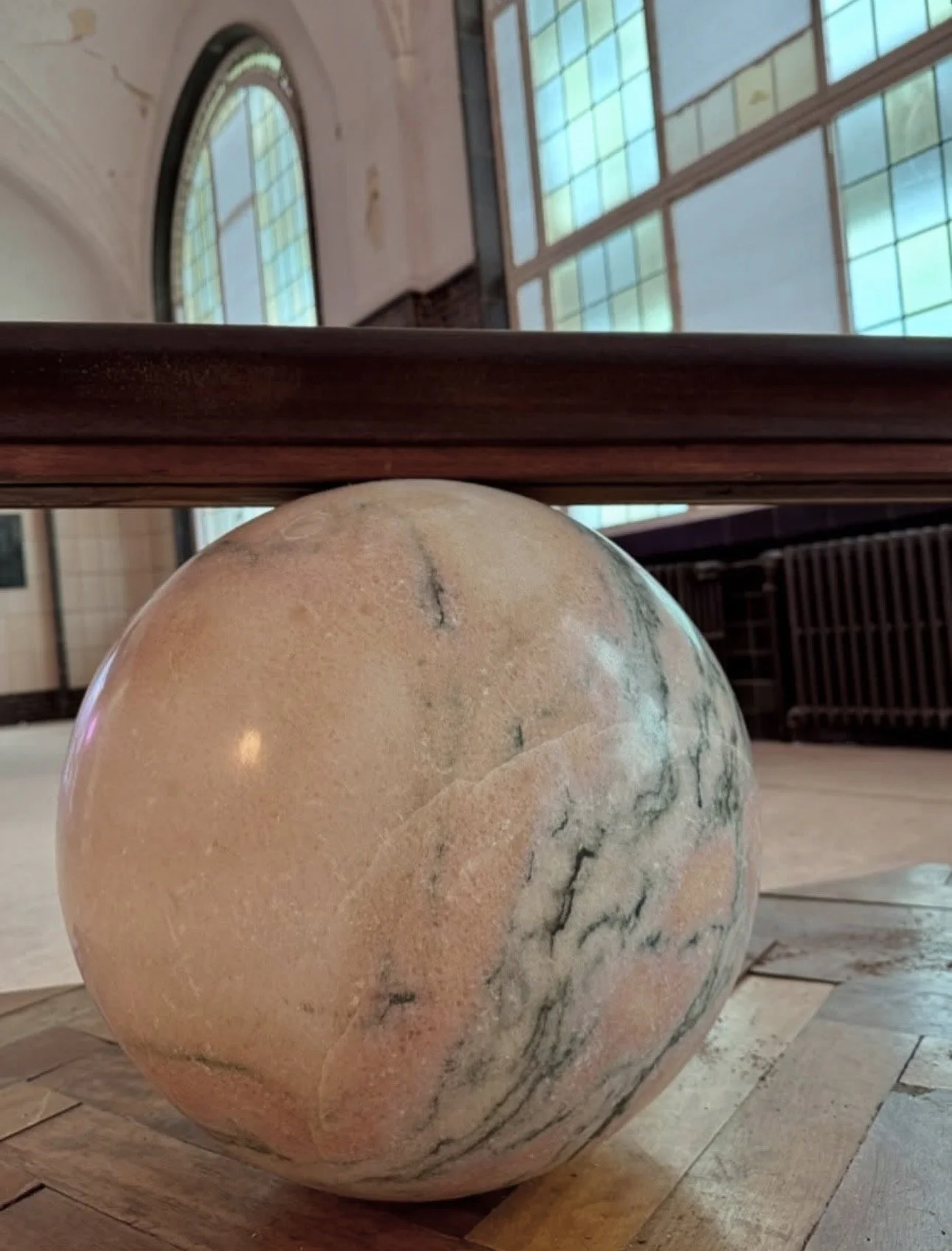
OP DE WIP (IN LIMBO)
2026
Pink marble sphere Ø 50 cm
OP DE WIP (IN LIMBO)
2026
238 x 44 x 75 cm
OP DE WIP (IN LIMBO)
2026
238 x 44 x 75 cm
The work “SHIT HAPPENS” presents a scaled-down courtroom, reduced to a setting for a single individual. In this way, the piece emphasizes the isolation and mental pressure that someone may experience during a trial. The visible imprint in the seat refers to tension that manifests itself both physically and psychologically.
Various toilet elements reinforce this visual language: the empty toilet roll symbolizes stress and exhaustion, while the flush button refers to tension and release. The combination of a toilet brush with a police baton connects everyday objects with authority and police violence. In this way, the installation brings together satire, discomfort, and social critique within one compact space.
The title Shit Happens humorously refers to the toilet elements present in the work, but at the same time emphasizes the inevitability of confronting situations within the justice system. In doing so, the work exposes both the absurdity and the human vulnerability of such experiences.
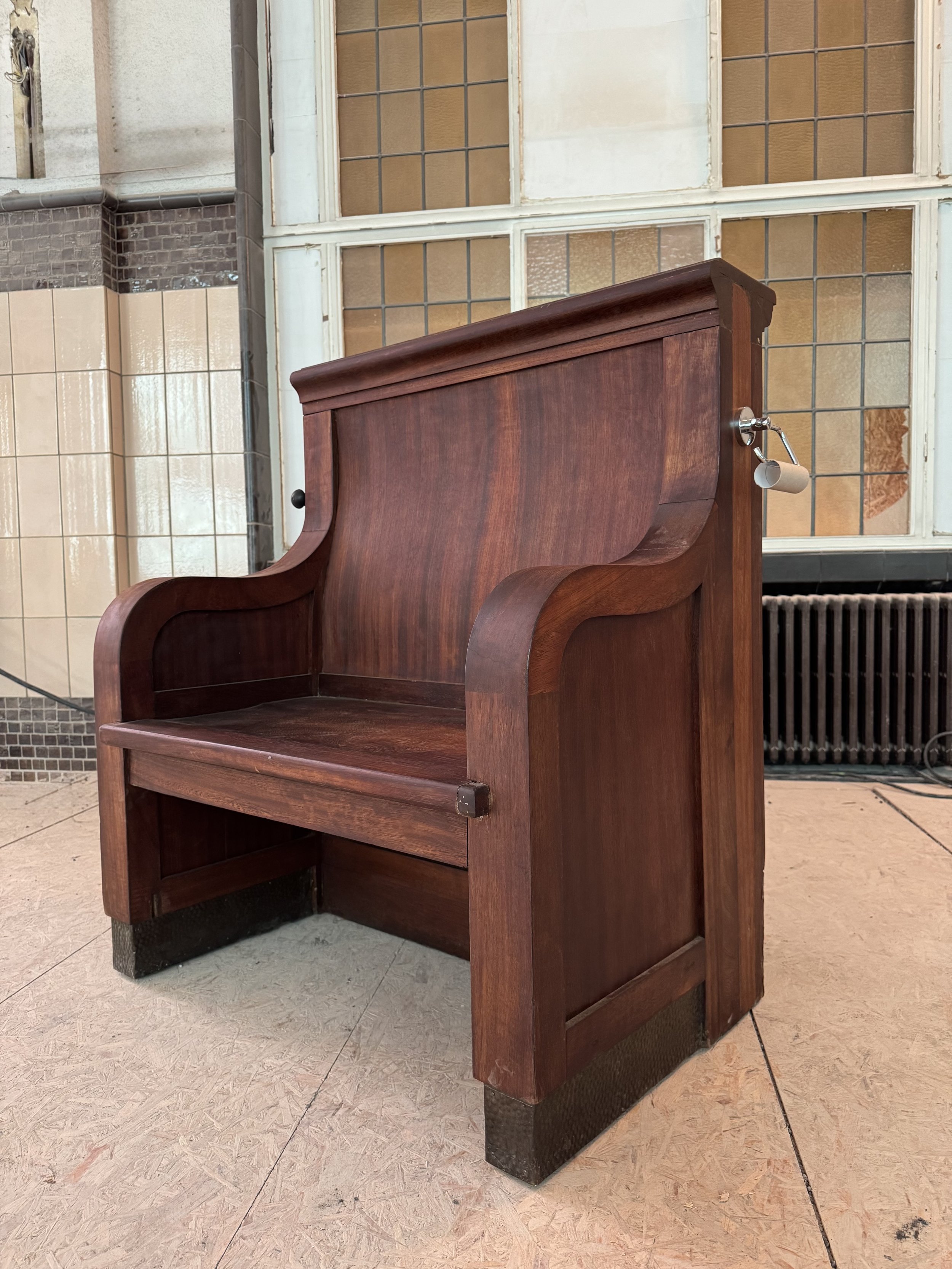
SHIT HAPPENS
2026
60 x 90 x 112 cm
Authentic courthouse bench fragments, Polyester police baton combined with toilet brush
Chrome toilet roll holder, Empty toilet paper roll
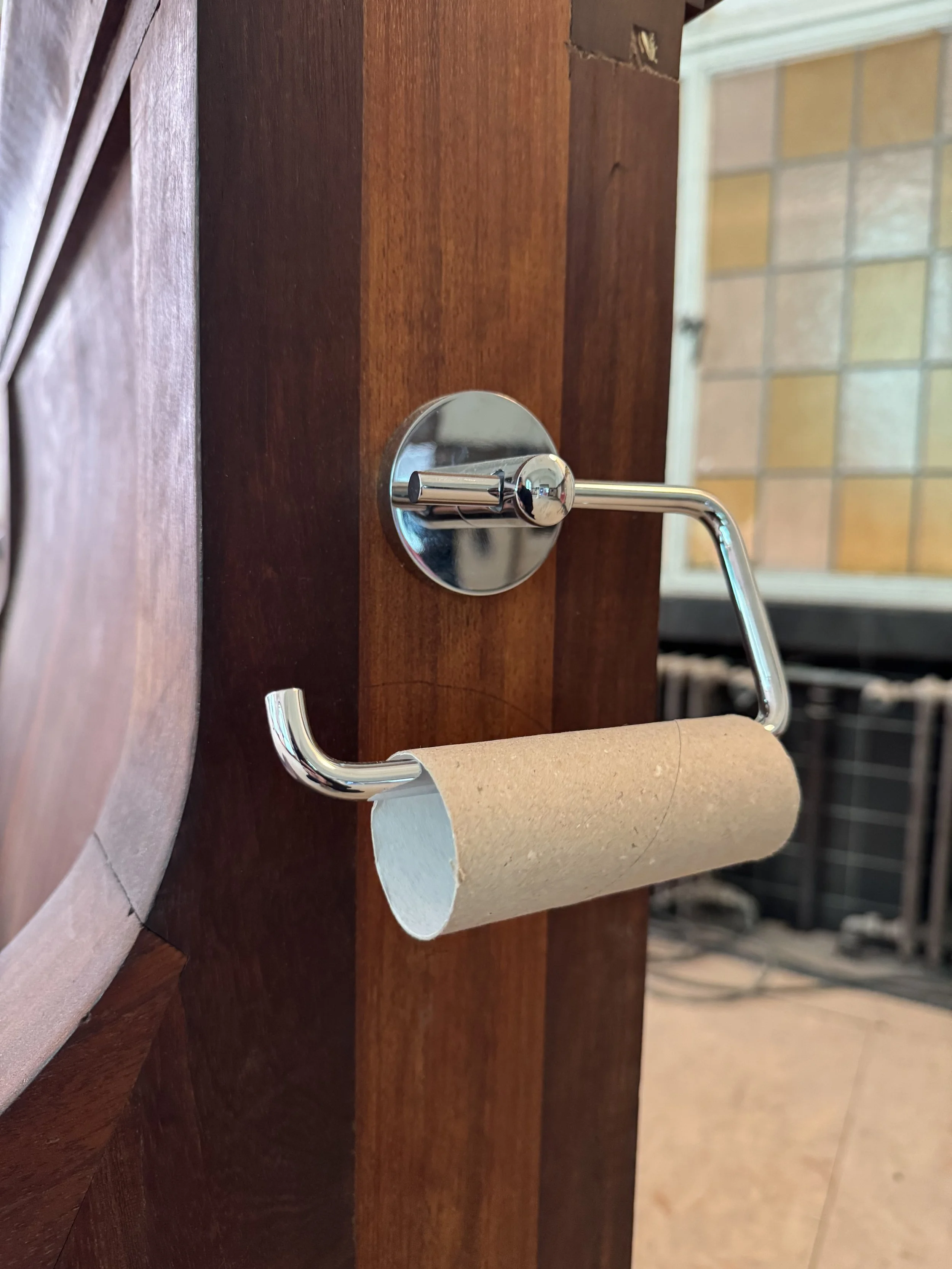
SHIT HAPPENS
2026
Details
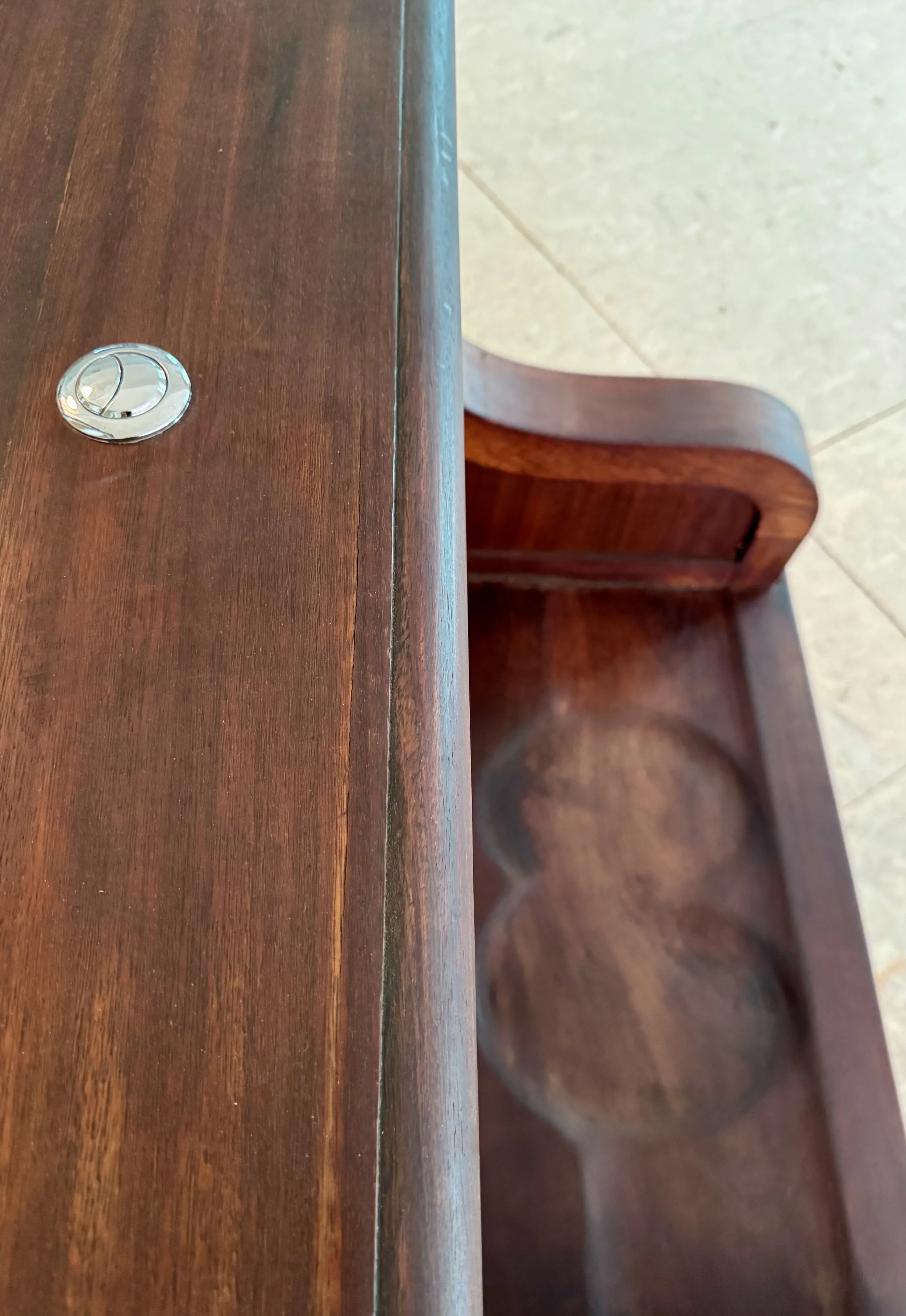
SHIT HAPPENS
2026
Close up
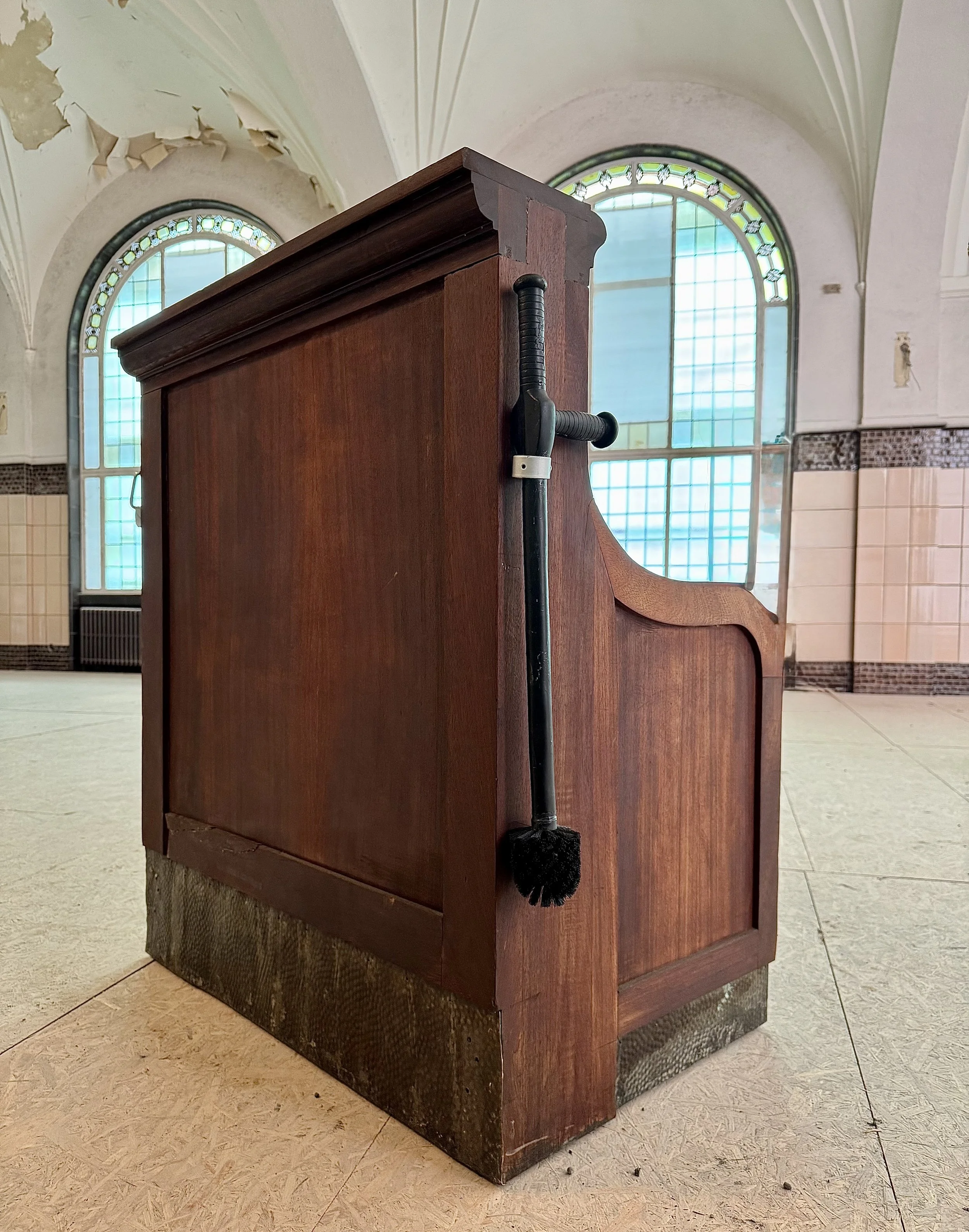
SHIT HAPPENS
2026
60 x 90 x 112 cm
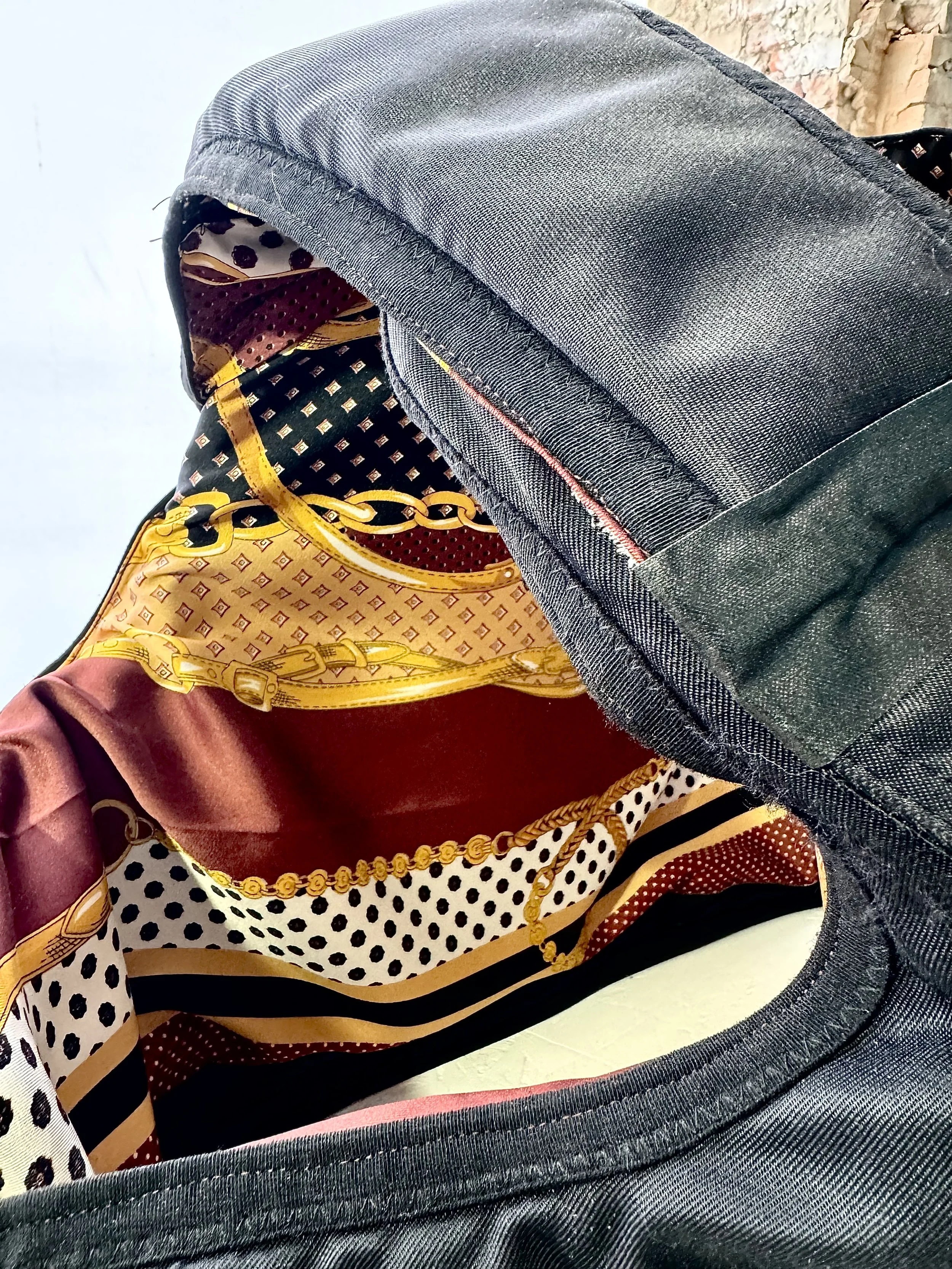
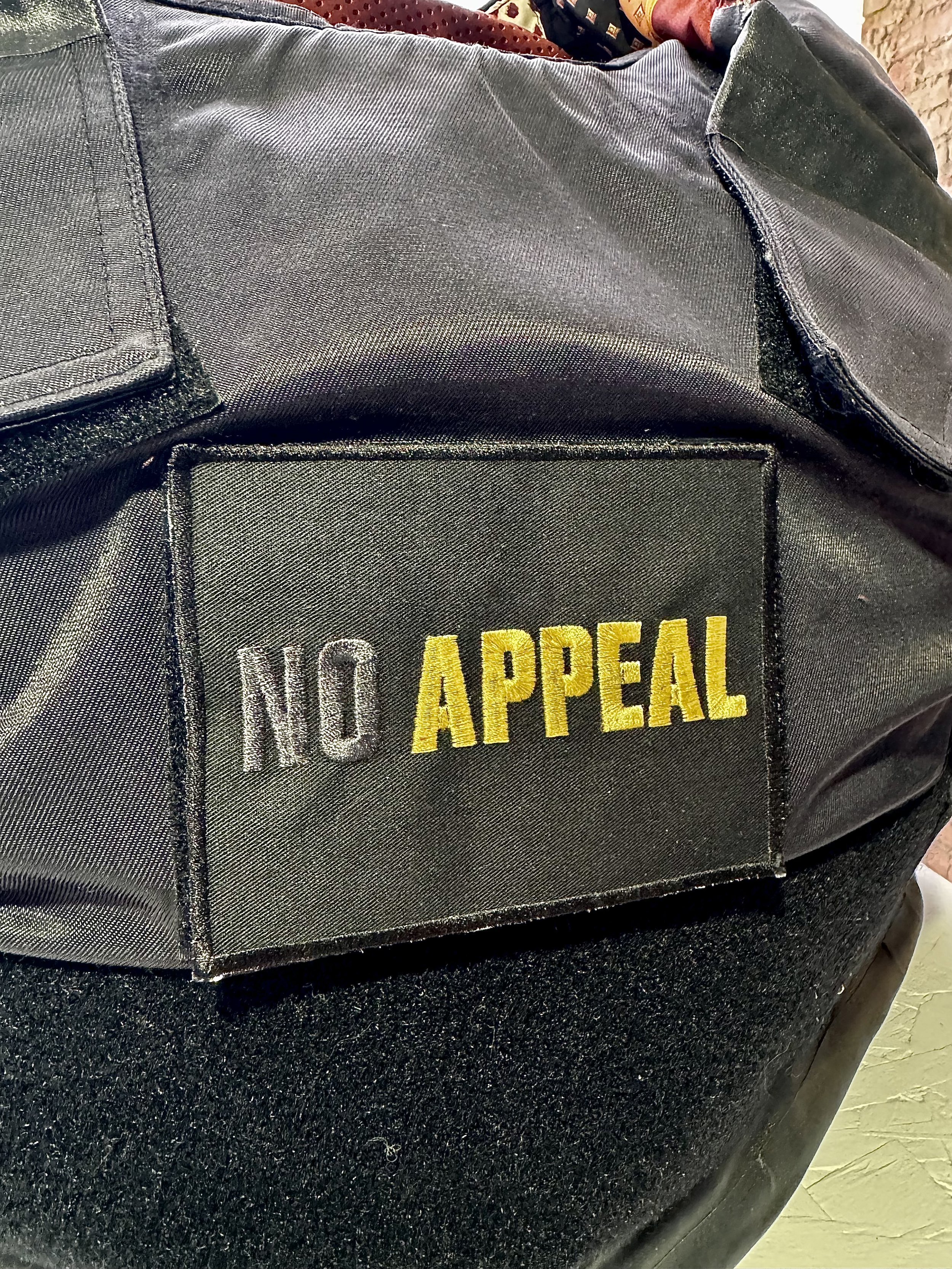
In “NO APPEAL”, an authentic bulletproof police vest takes center stage. The hard, protective exterior contrasts sharply with the inner lining, finished in refined luxury fabric. This intervention exposes the tension between protection and privilege: who is granted protection within certain social structures, and who is not.
In the place where police patches would normally appear, the text No Appeal is displayed — literally meaning that no appeal is possible. The word Appeal is rendered in gold, while No remains black. This contrast refers to class justice and inequality within the legal system, where access to defense, appeal, or a fair hearing is not equally available to everyone. The vest thus becomes not only a symbol of physical protection, but also of a system that shields and safeguards certain positions of power.
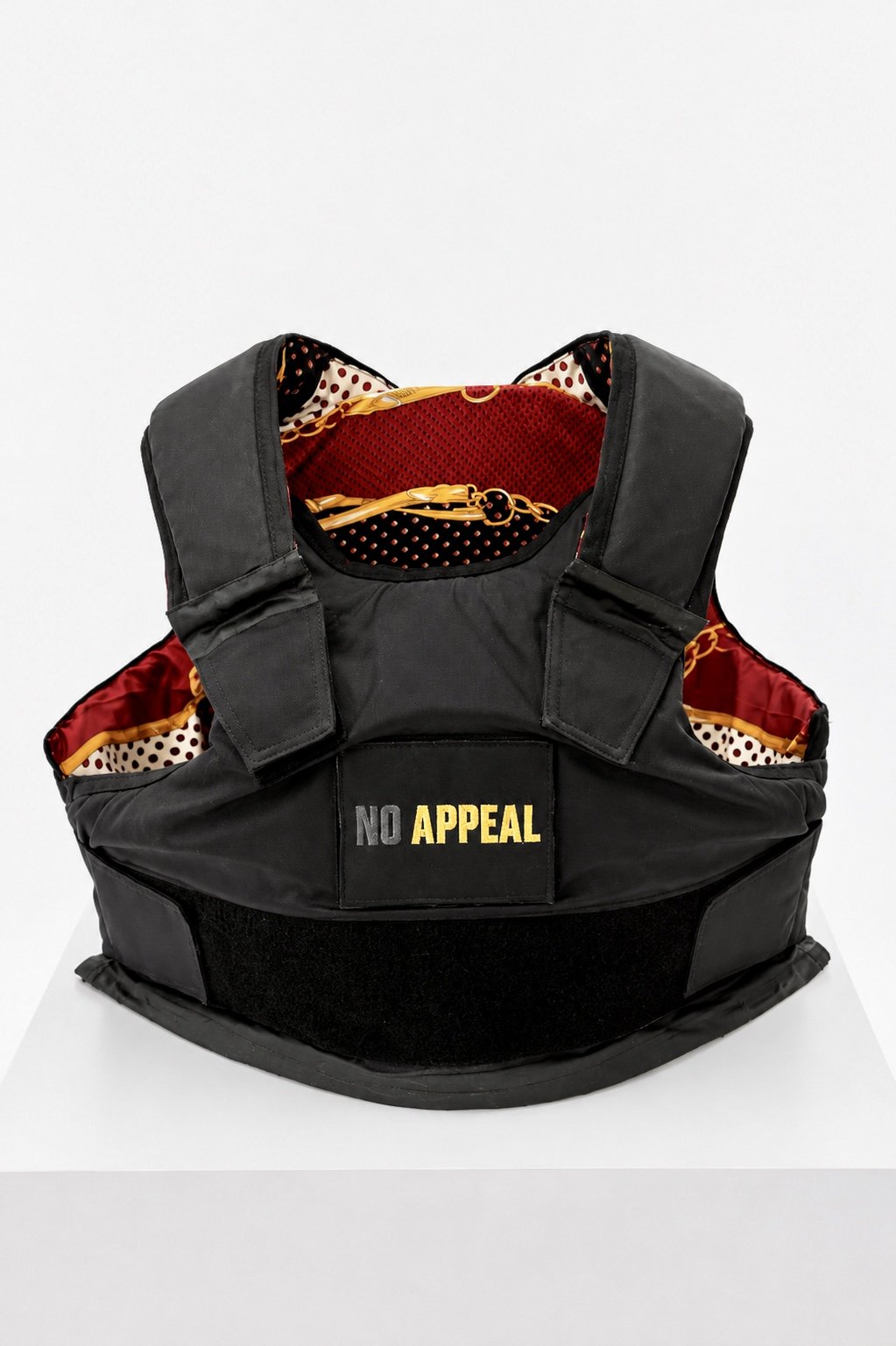
BENCHMARKS / (NO) APPEAL
2026
55 x 50 x 40 cm
Authentic police bulletproof vest, finished with luxury printed fabric and custom-stitched Velcro patch
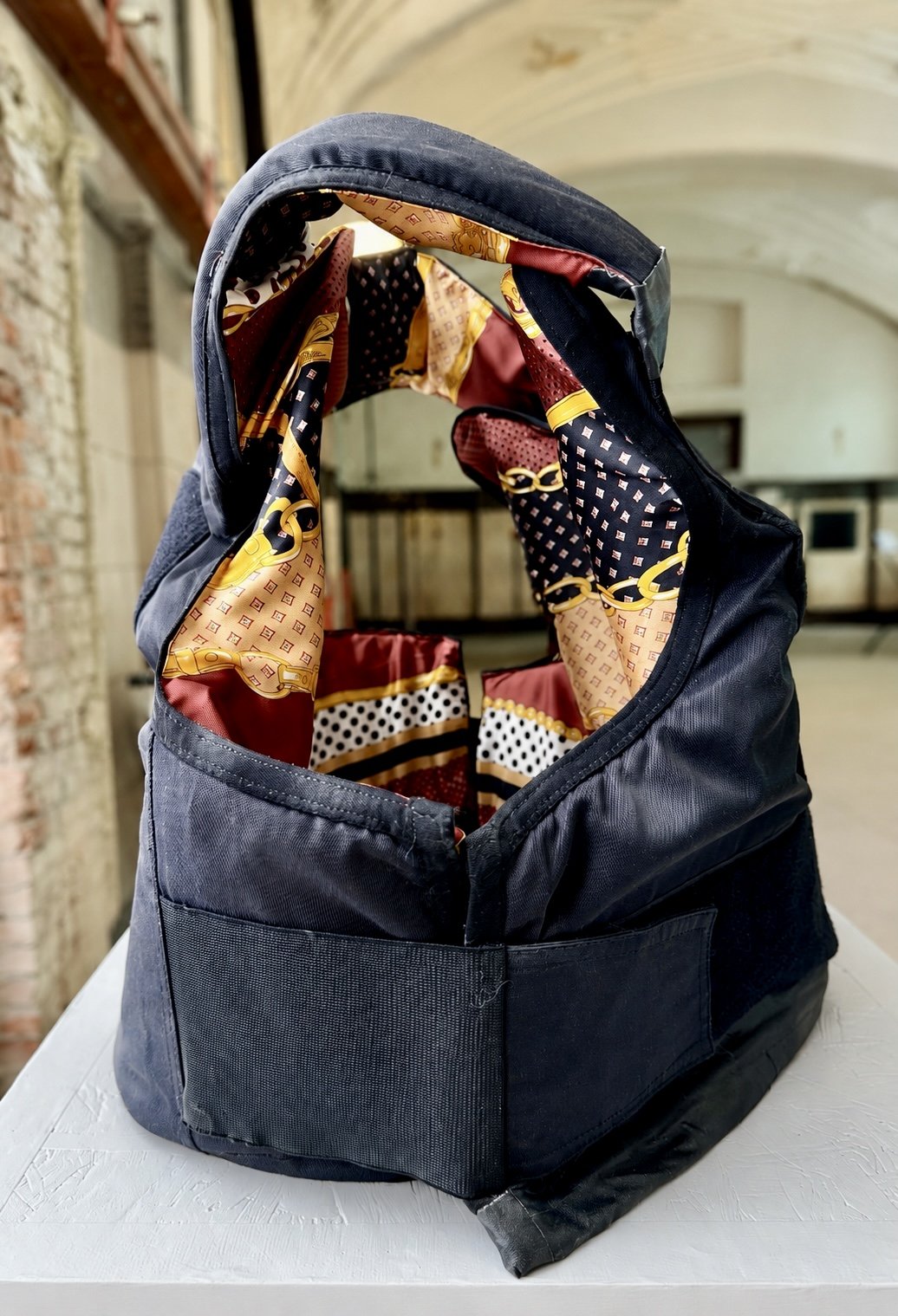
BENCHMARKS / (NO) APPEAL
2026
Details
BENCHMARKS / (NO) APPEAL
2026
Details
BENCHMARKS / (NO) APPEAL
2026
Details
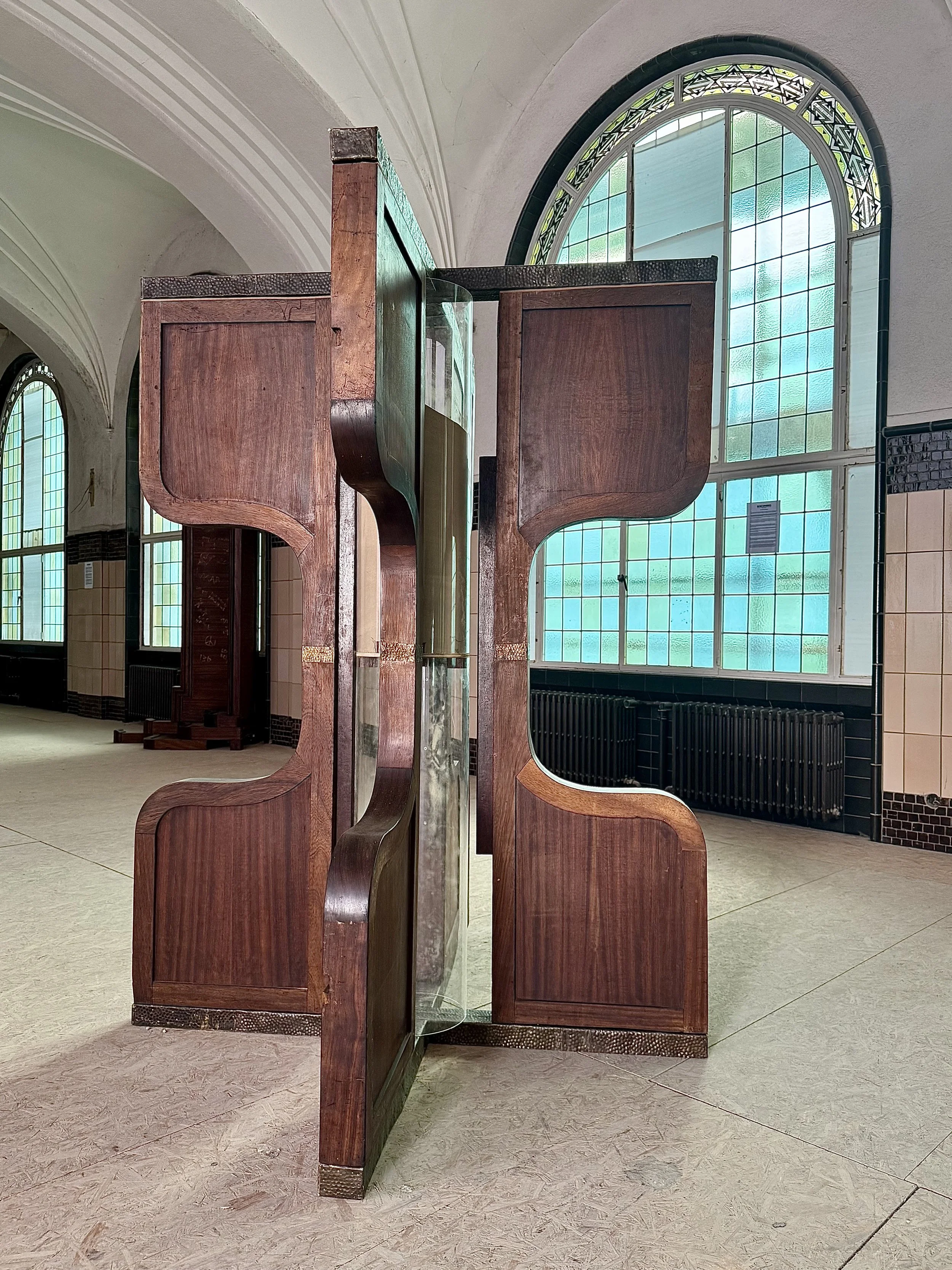
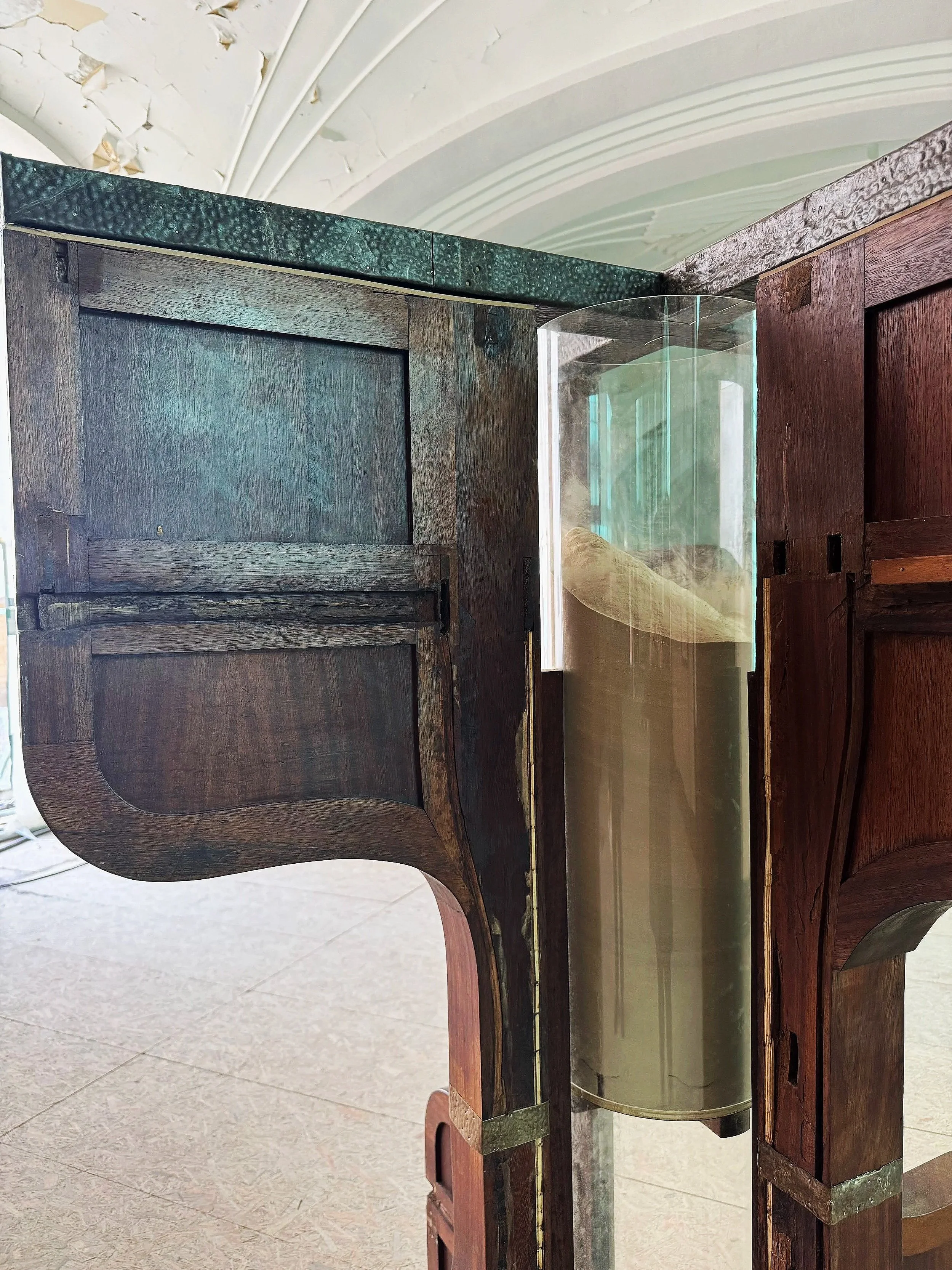
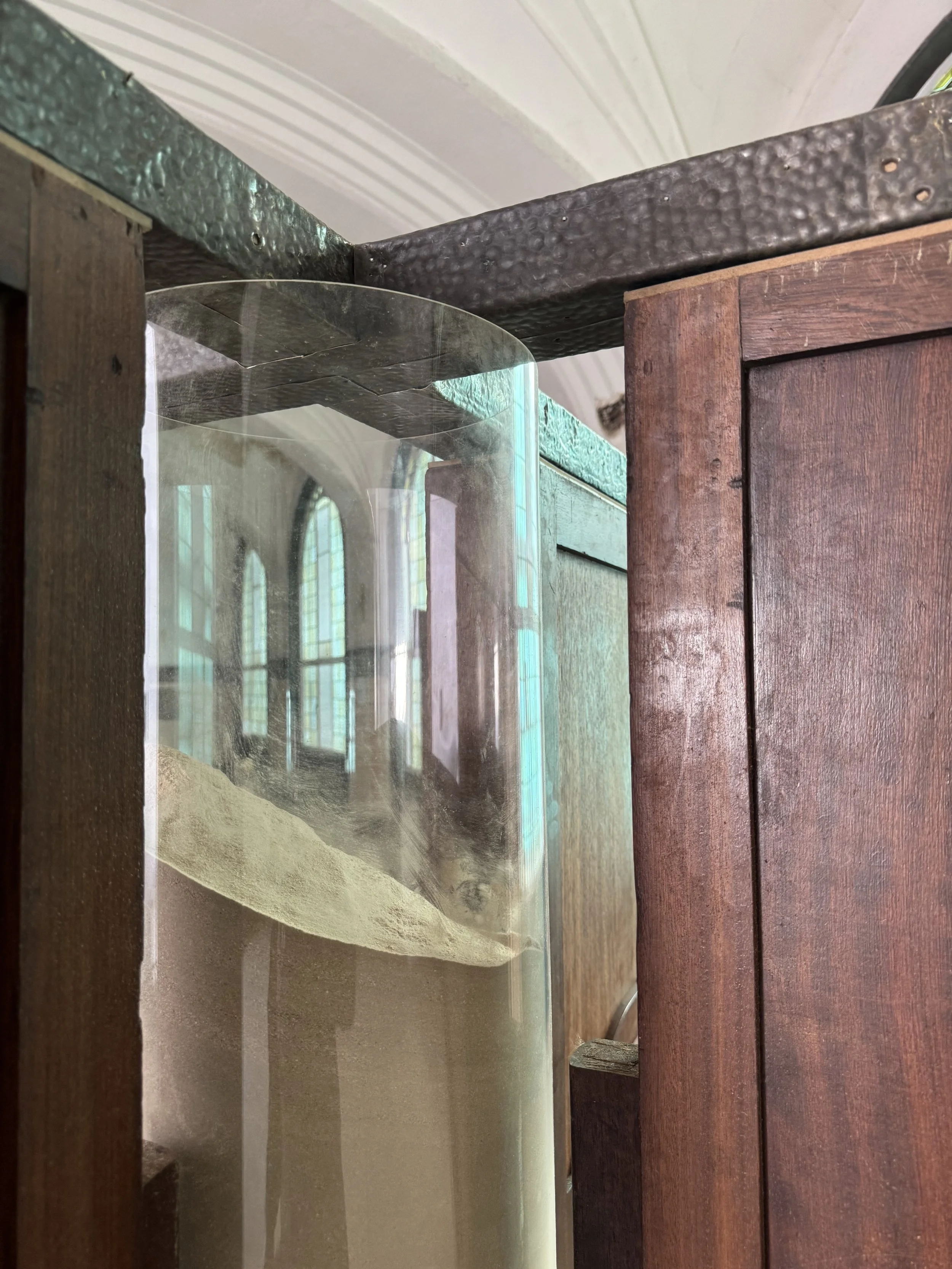
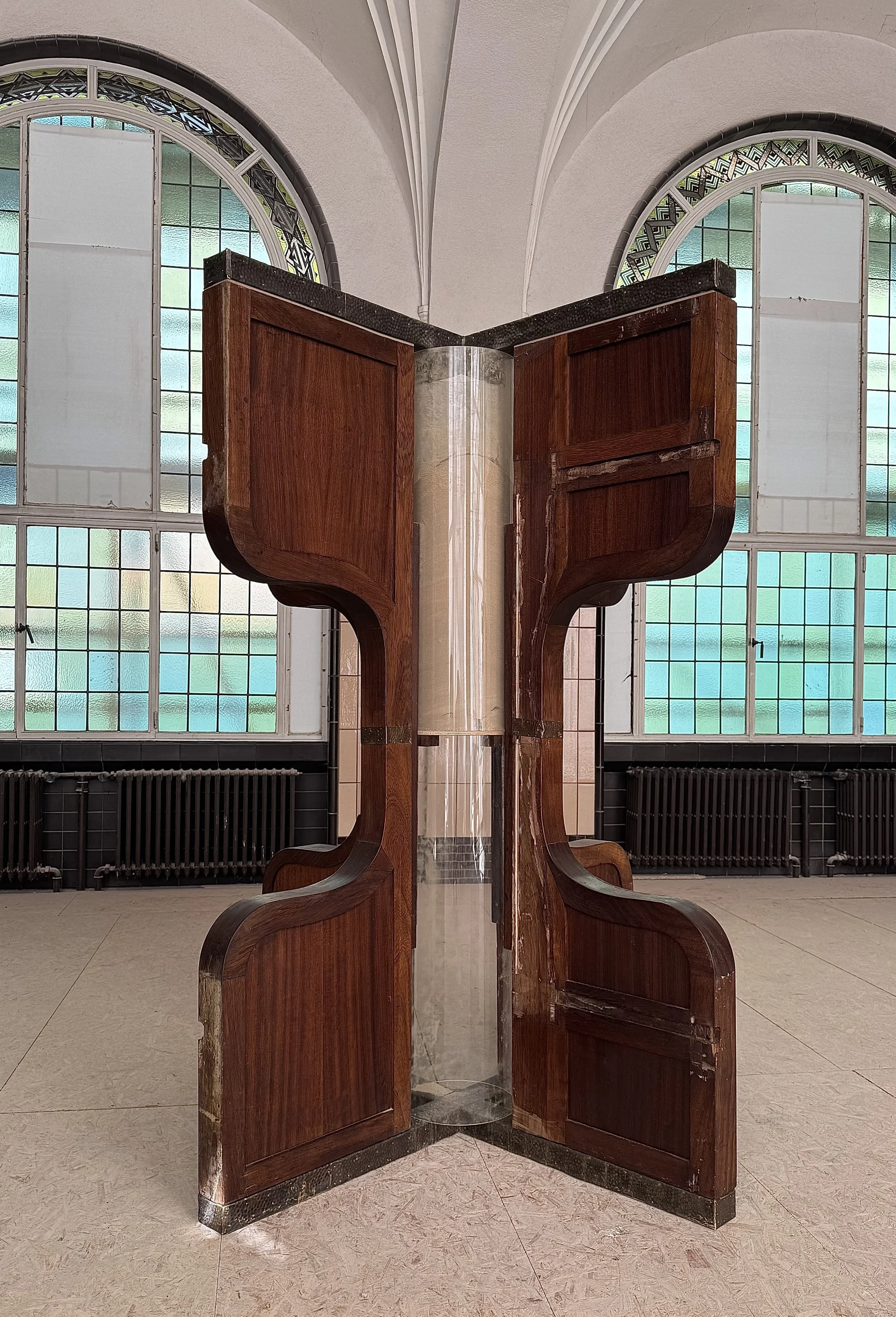
This installation uses the shape of an hourglass to portray the courthouse as an institution that is slowly exhausting itself. The sand has been replaced by sawdust from the benches themselves, creating the impression that the courthouse is consuming itself. The material of the structure simultaneously becomes the residue of its own decay.
In a traditional hourglass, the sand flows from top to bottom, symbolizing the continuous passage of time. Here, that flow is blocked by a piece of wood in the center. The sawdust remains suspended in the upper section, while the lower part stays empty. As a result, an image of stagnation emerges: a system that has hollowed itself out, yet is no longer capable of moving forward or renewing itself.
The Dutch title “STILSTAND VAN ZAKEN” functions satirically. The expression normally refers to an overview of how a situation is progressing, but here it takes on an ironic meaning: matters quite literally remain “standing still,” without progress. The work refers to the slowness of bureaucracy and the justice system in Belgium, where procedures can drag on for years, prisons become overcrowded, and systems become trapped within their own structures. The hourglass no longer measures time — it reveals the loss of time.
BENCHMARKS / STILSTAND VAN ZAKEN
2026
150 x 150 x 200 cm
Plexi glass tubes, Ø 30 cm, Authentic courthouse elements
Stilstand van zaken
2026
Details
Stilstand van zaken
2026
Close up
Stilstand van zaken
2026
150 x 150 x 200 cm
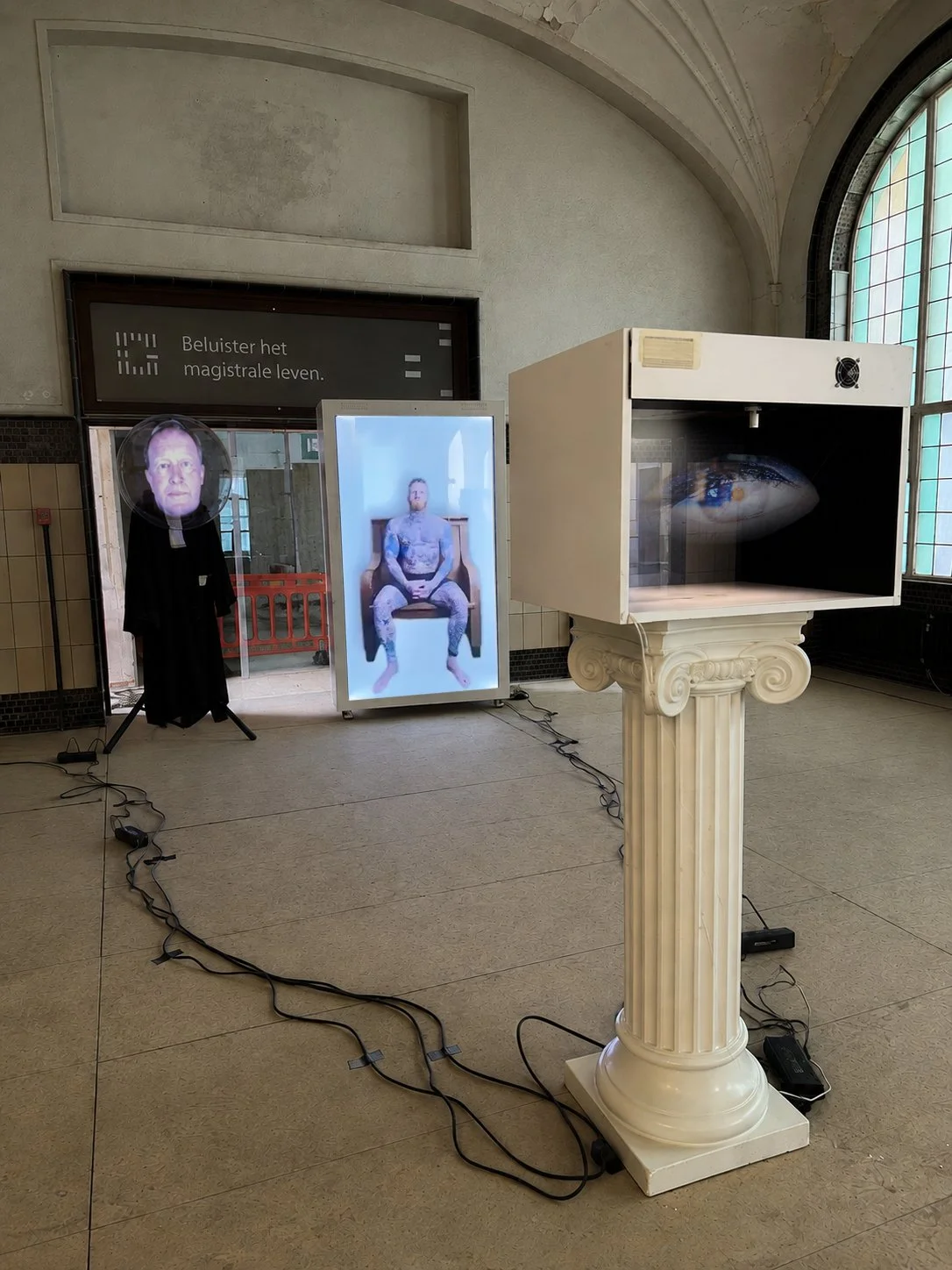
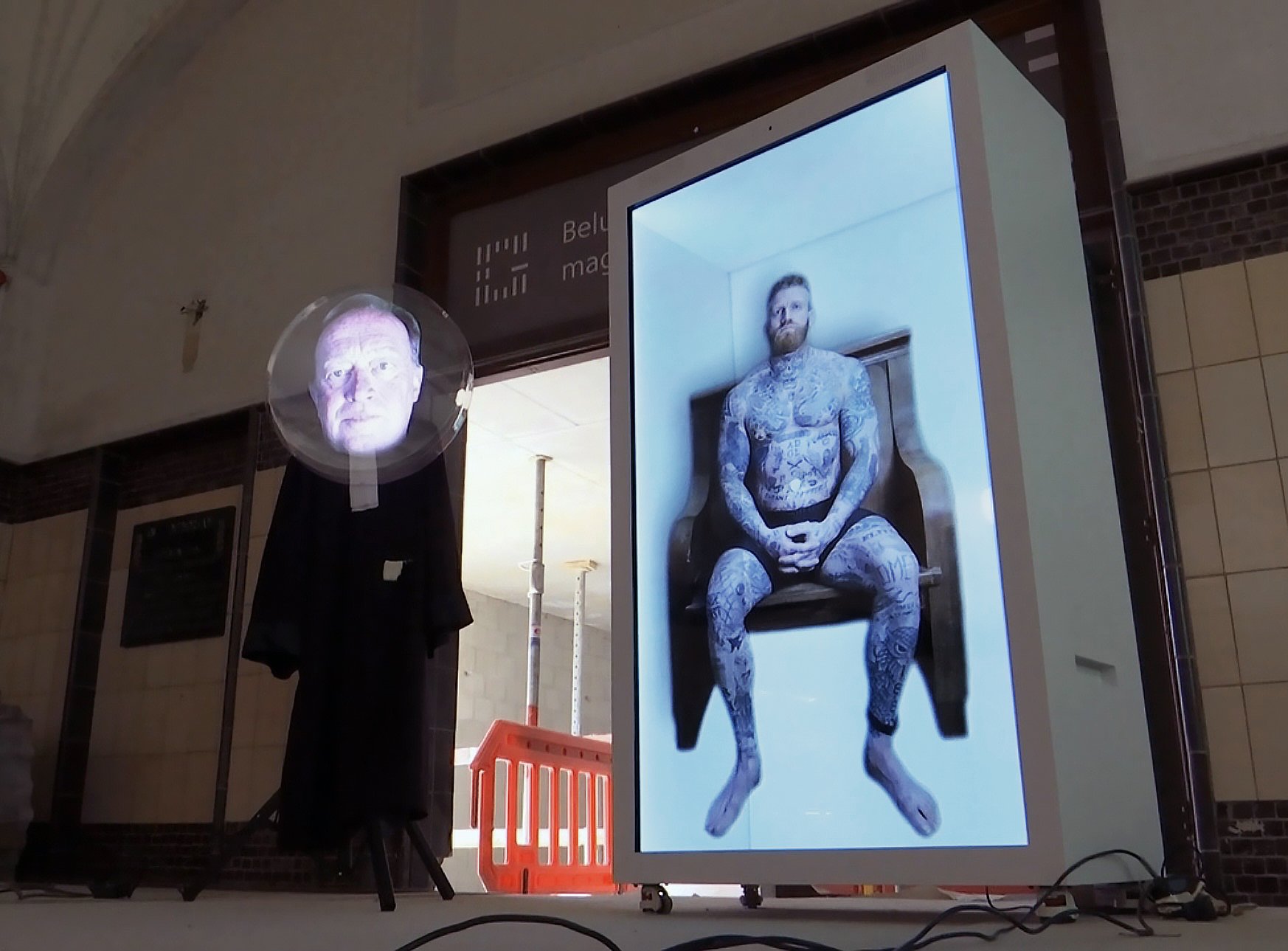
In “REMOTE JUSTICE” the individuals appearing in this installation are not actors, but the actual people they represent: a detainee wearing an electronic ankle monitor, a judge, and a lawyer. Within Benchmarks, the work explores what justice may look like in a future that is becoming increasingly digital and distant.
At the center appears a hologram of a detainee seated on a courtroom bench. His body, reduced to a vulnerable and exposed state, refers to powerlessness and control. Because the person portrayed has genuinely been detained, the image gains a direct sense of reality. Yet his presence is filtered through technology: he is simultaneously present and absent.
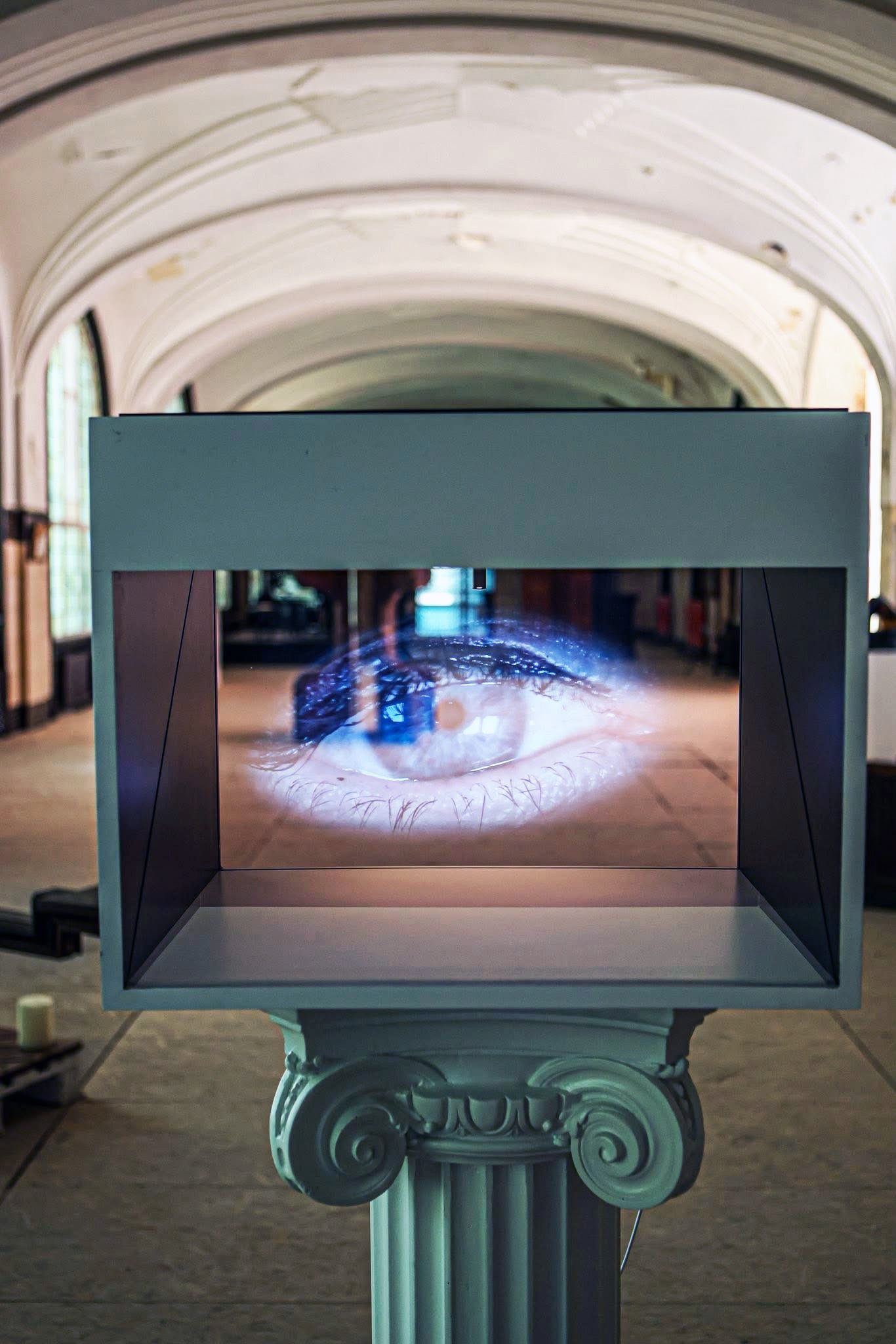
Alongside him appears a hologram of a lawyer in a robe, symbolizing tradition and authority within a system that continues to modernize while still holding onto its rituals. The judge does not appear as a body, but as a holographic eye — a symbol of observation, control, and judgment.
All elements are connected through cables visibly spread across the floor. They form the infrastructure of the system and demonstrate how justice is becoming increasingly dependent on networks, signals, and technology. The installation thus depicts a shift from human presence to digital representation, raising the question of what is lost when justice increasingly takes place at a distance.
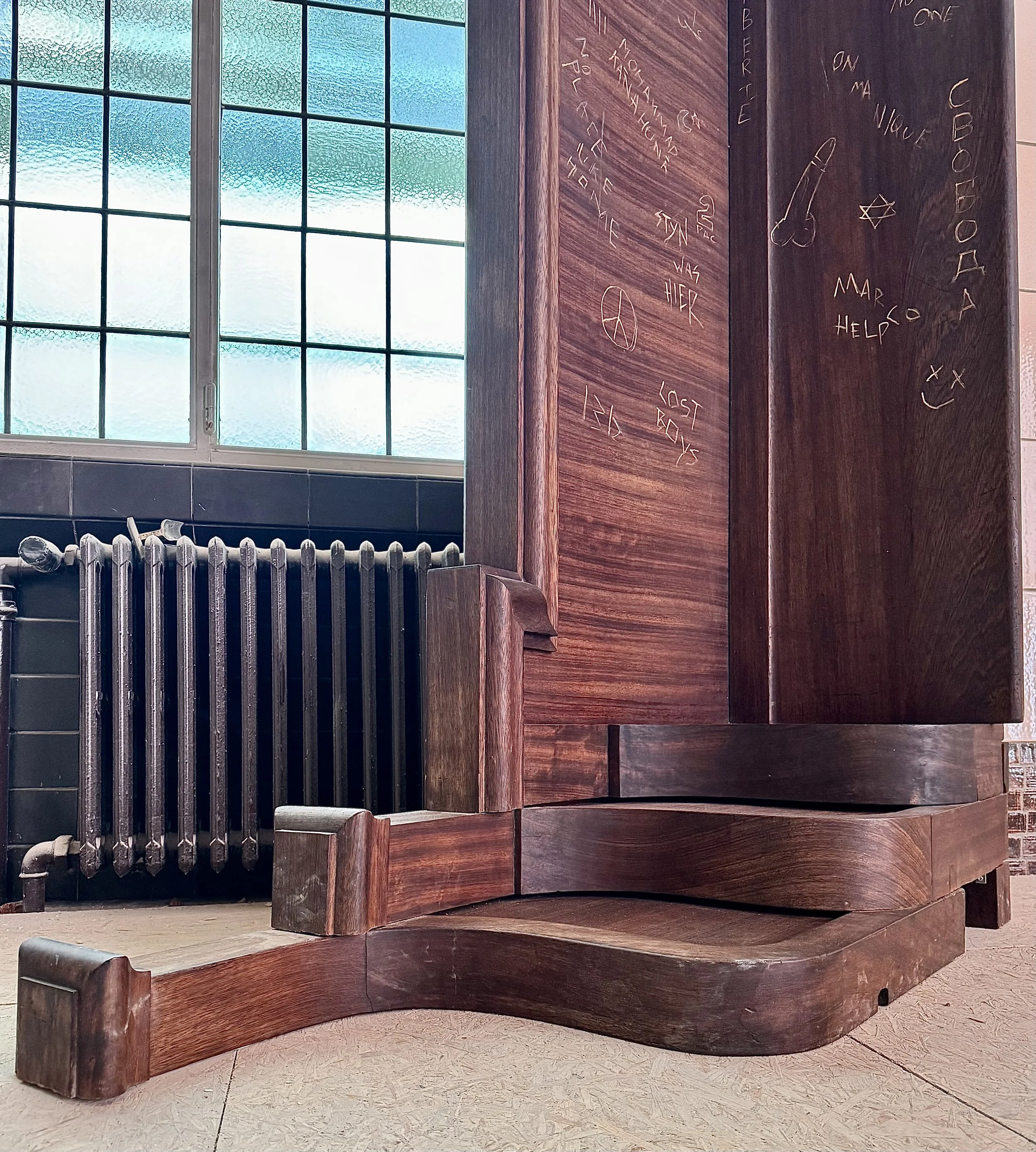
In this installation, we see an upright bench with several steps leading the visitor toward the corner. The work refers to the familiar image from childhood: “IN DE HOEK (TIME OUT)” as a moment of punishment and reflection. Out of boredom, we often leave traces of ourselves there — scribbles, drawings, or words.
That same human urge can also be found in prison cells. During research into prison cell interiors, the same kinds of signs repeatedly appeared: names, religious symbols, political statements, messages, or memories of people who are missed. They are traces of identity within a confined space.
These elements have been scratched into the work by hand and treated with a bronze-like paint. Through this treatment, the scribbles and marks acquire an almost monumental value, as if these small human signs are preserved as silent witnesses of presence, memory, and identity.
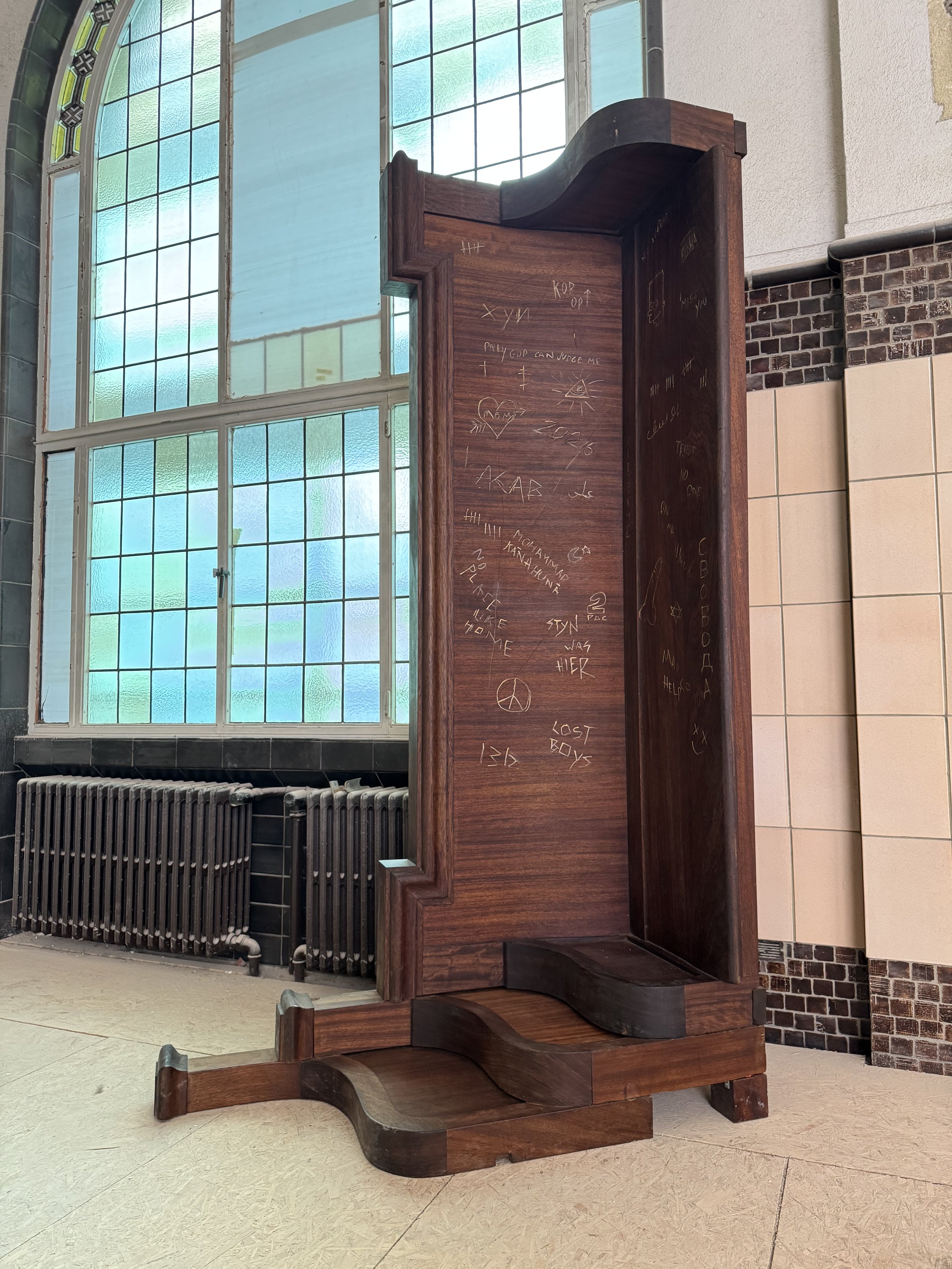
BENCHMARKS / IN DE HOEK (TIME OUT)
2026
232 x 127 x 59 cm
Authentic courthouse bench fragments, Hand-engraved drawings and text with bronze color finish
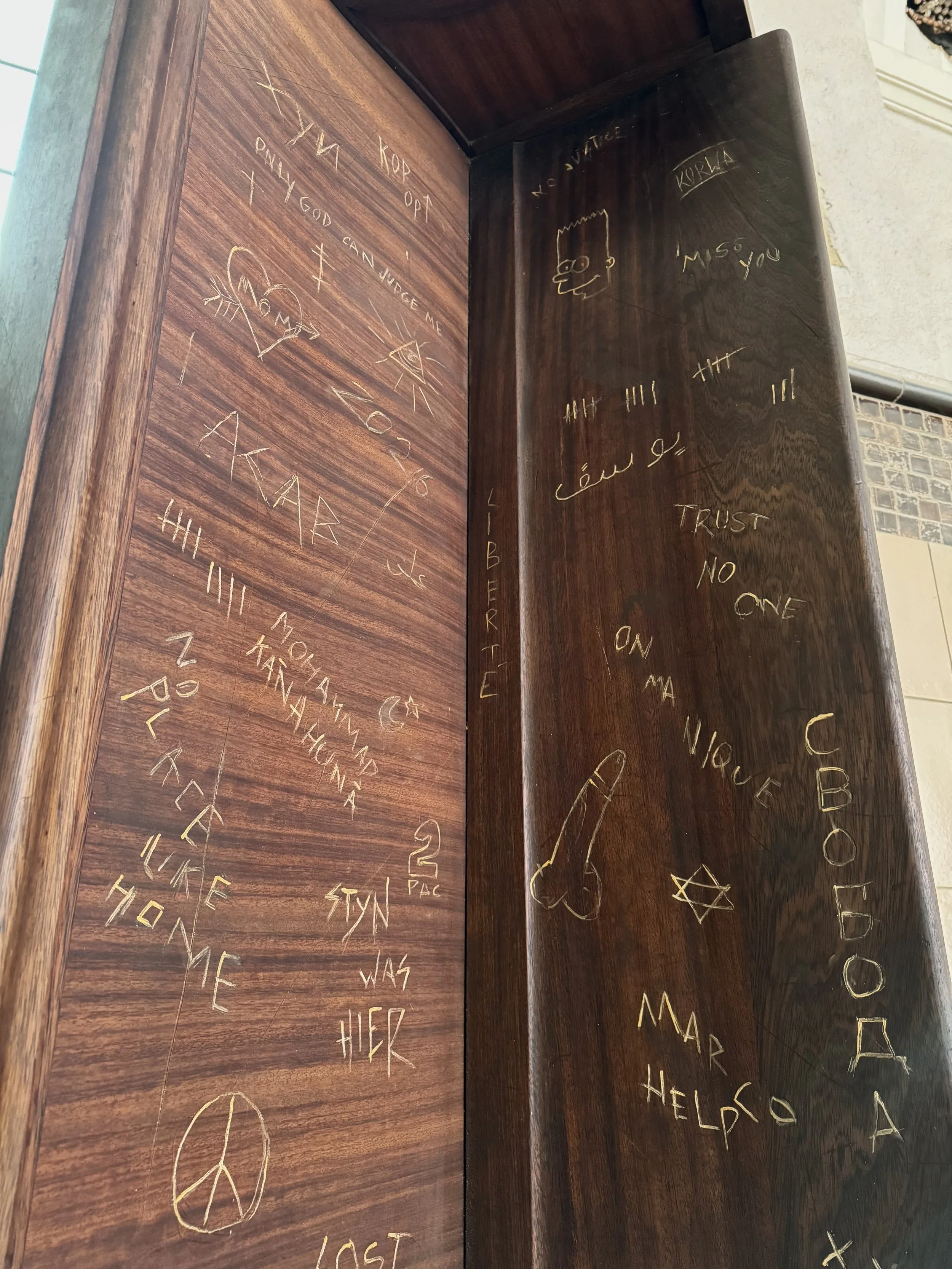
BENCHMARKS / IN DE HOEK (TIME OUT)
2026
Close up
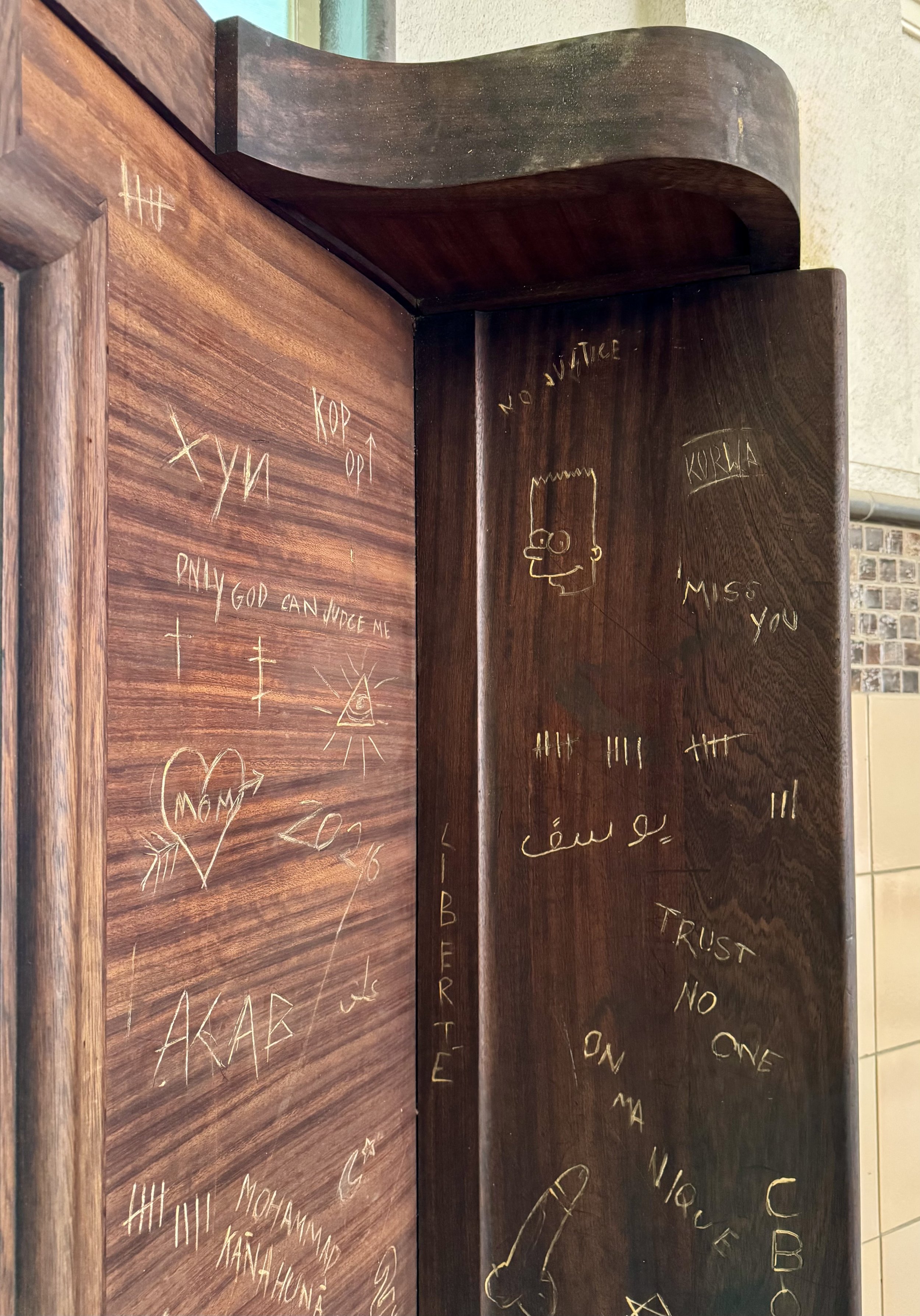
BENCHMARKS / IN DE HOEK (TIME OUT)
2026
Close up
BENCHMARKS / IN DE HOEK (TIME OUT)
2026
Close up
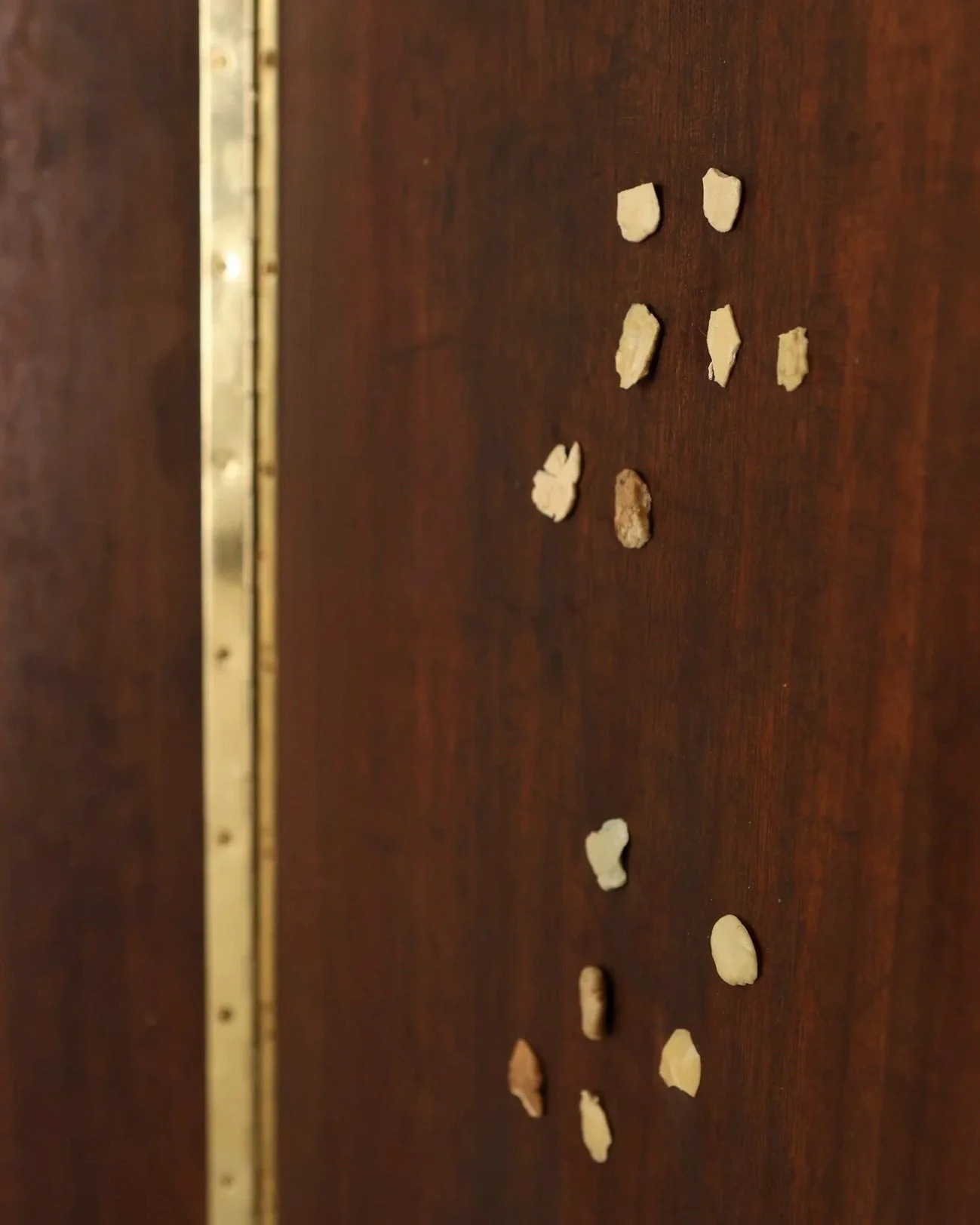
In ‘BLIND JUSTICE”, two wooden panels from former courtrooms are presented as a contemporary reference to the tablets of Moses. They bear the traces of human presence, judgment, and tension.
On the panels appears a text from 1 to 10 in braille, formed from cigarette butts and chewing gum found beneath the courtroom benches. These everyday remnants become tangible witnesses of nervousness, uncertainty, and the anticipation of judgment. By making them visible and restructuring them, the artist transforms hidden waste into human relics.
The choice of braille refers to Justitia, the blind symbol of justice. At the same time, the work confronts the viewer with the limits of perception and with the question of who is truly able to “read” justice.
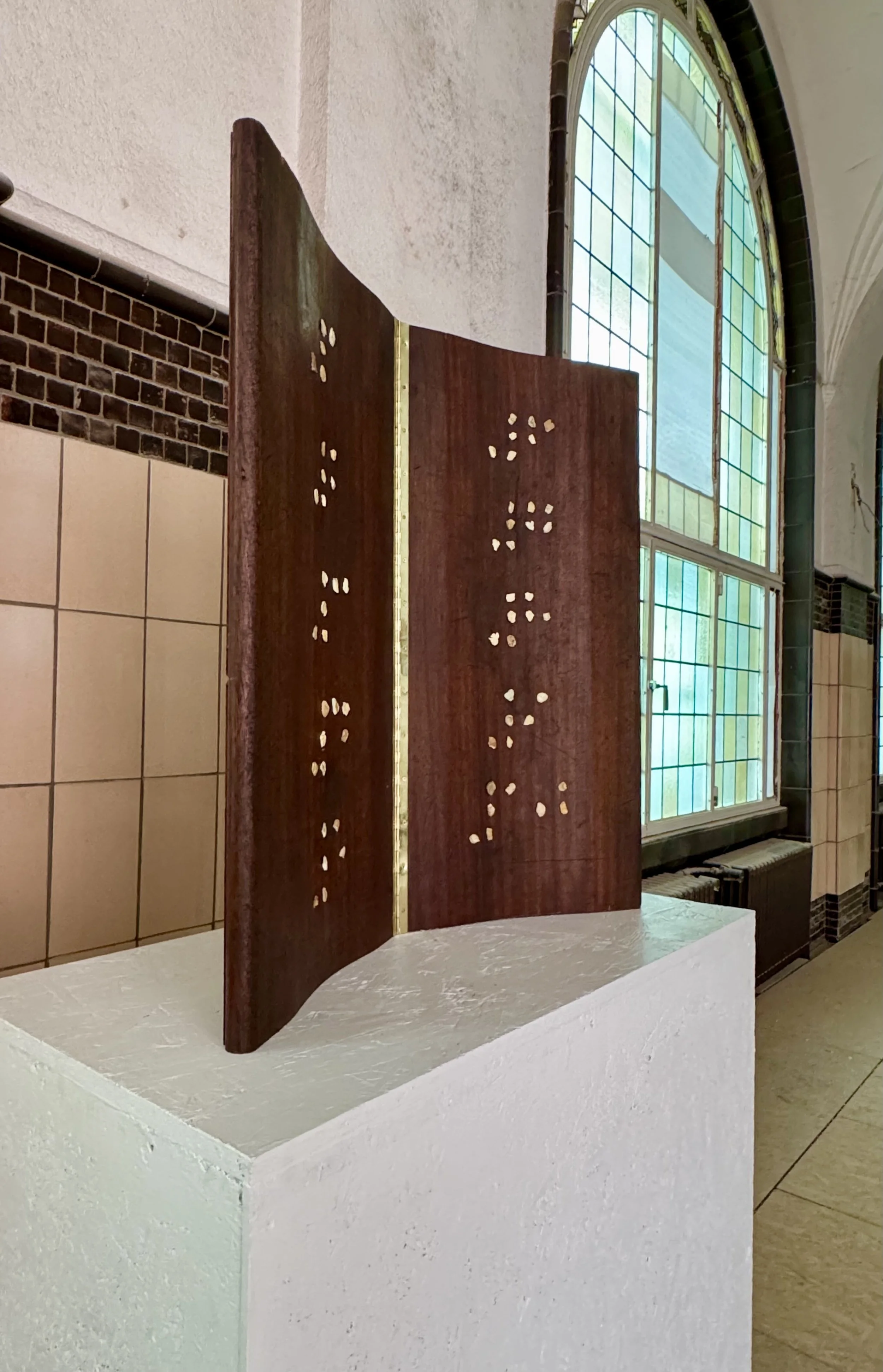
BENCHMARKS / BLIND VERDICT
2026
80 x 84 x 5 cm
Authentic courthouse bench fragments
Authentic courthouse bench “bubblegum”
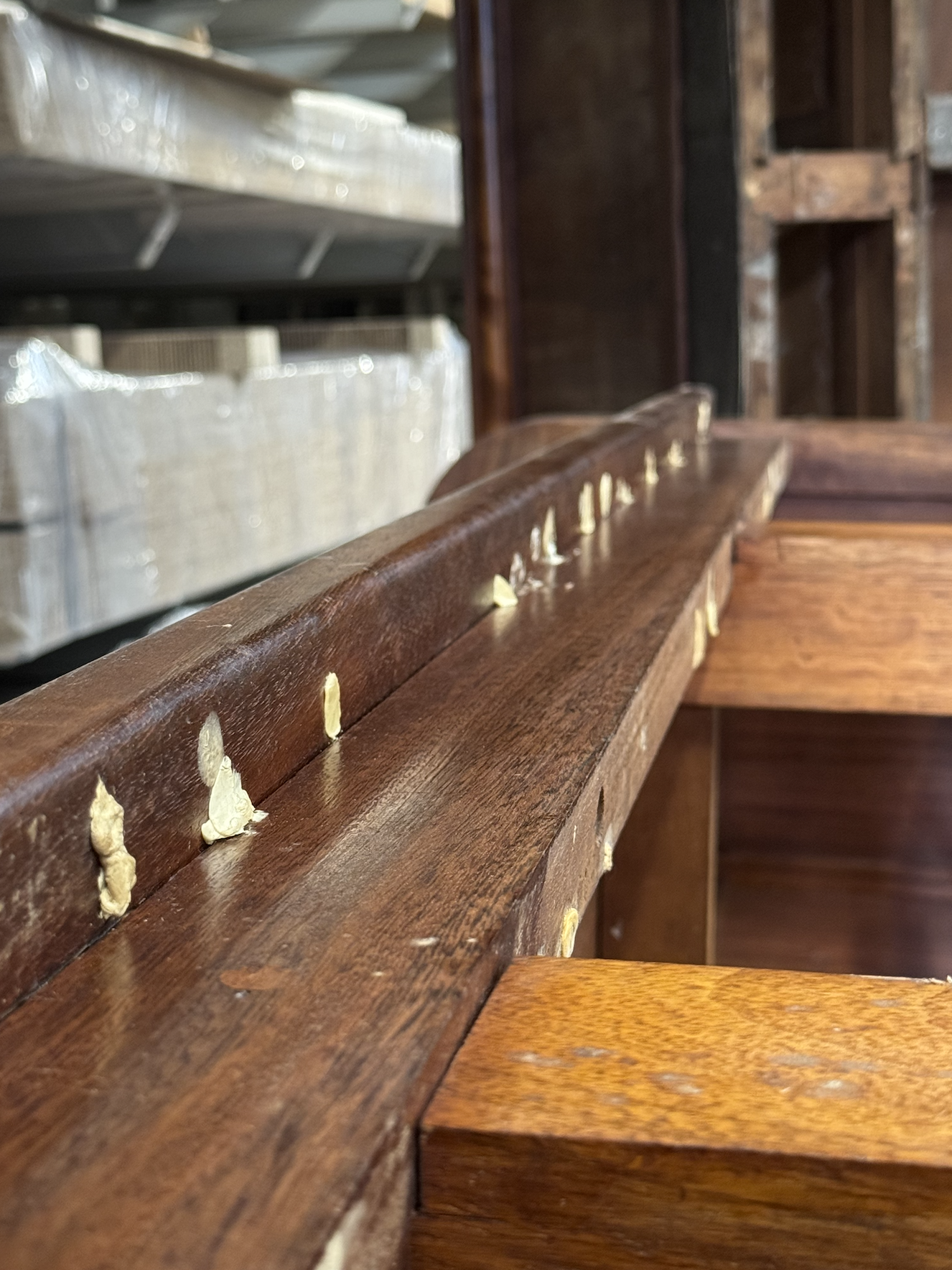
BENCHMARKS / BLIND VERDICT
2026
Authentic courthouse bench “bubblegum”
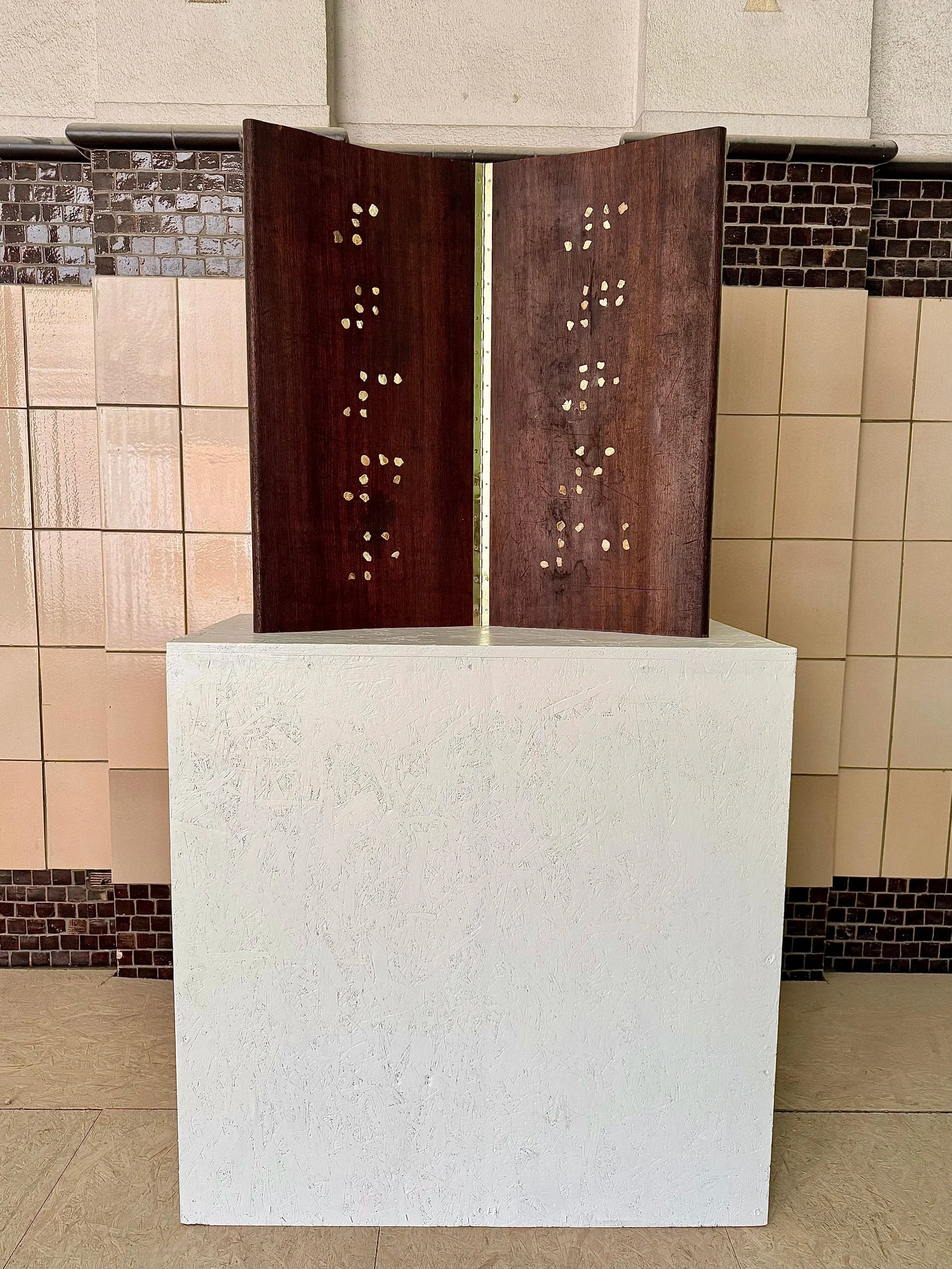
BENCHMARKS / BLIND VERDICT
2026
80 x 84 x 5 cm
Authentic courthouse bench fragments
Authentic courthouse bench “bubblegum”
BENCHMARKS / BLIND VERDICT
2026
Close up
© Text by Lara Van Oudenaarde.
© Photos by Tom Herck.
Quisque iaculis facilisis lacinia. Mauris euismod pellentesque tellus sit amet mollis.